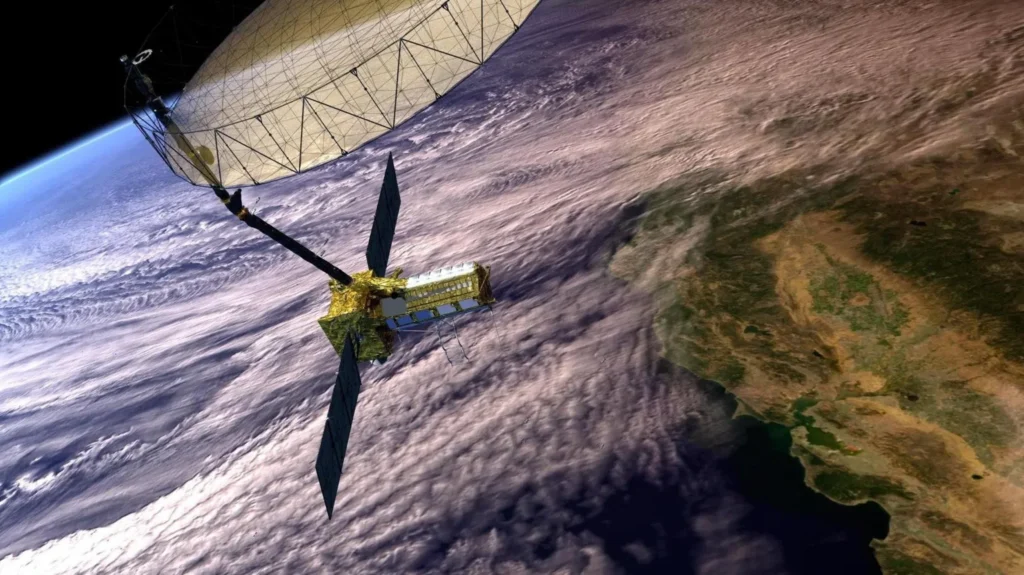
In a historic leap for global Earth observation, the Indian Space Research Organisation (ISRO) and NASA have successfully launched Nisar, a cutting-edge satellite designed to detect even the smallest changes in Earth’s surface — from glaciers to coastlines, farmland to fault lines.
The 2,392kg satellite, equipped with dual-frequency Synthetic Aperture Radar (NASA’s L-band and ISRO’s S-band), was launched on Wednesday at 17:40 IST (12:10 GMT) from the Satish Dhawan Space Centre in southern India. The mission, valued at $1.5 billion, represents over a decade of collaboration and is being hailed as a milestone in India–US space partnership.
“This is going to be yet another great day for India,” said ISRO Chairman V. Narayanan, calling Nisar a “life-saving satellite” and a symbol of India’s growing leadership in space technology.
The satellite will enter a sun-synchronous polar orbit, allowing it to pass over the same regions every 12 days, creating detailed maps of the Earth’s surface and detecting changes as small as a few centimetres. These repeated scans will generate invaluable data for climate monitoring, disaster preparedness, and environmental research.
“With Nisar, we’ll see precursors to natural hazards like earthquakes, landslides, and volcanic activity, as well as human-induced land changes,” said Karen St. Germain, NASA’s Director of Earth Sciences.
The mission’s potential impact is vast — from tracking glacier melt in Greenland and Antarctica, to monitoring deforestation, urban expansion, agricultural patterns, and critical infrastructure shifts. The satellite will take about 90 days to fully deploy and begin its scientific operations after all systems are tested.
This landmark launch comes shortly after India’s AX-4 astronaut mission and follows recent achievements including the Chandrayaan-3 lunar south pole landing and the Aditya-L1 solar mission. With Gaganyaan (India’s first human spaceflight) scheduled for 2027, and plans for a space station by 2035, ISRO continues to position itself as a rising global space leader.
“Nisar is not just a satellite; it is India’s scientific handshake with the world,” said India’s Science Minister Jitendra Singh, calling it a defining moment in bilateral space cooperation.
As the world grapples with escalating climate threats and natural disasters, Nisar stands as a powerful tool for understanding — and safeguarding — the planet.
