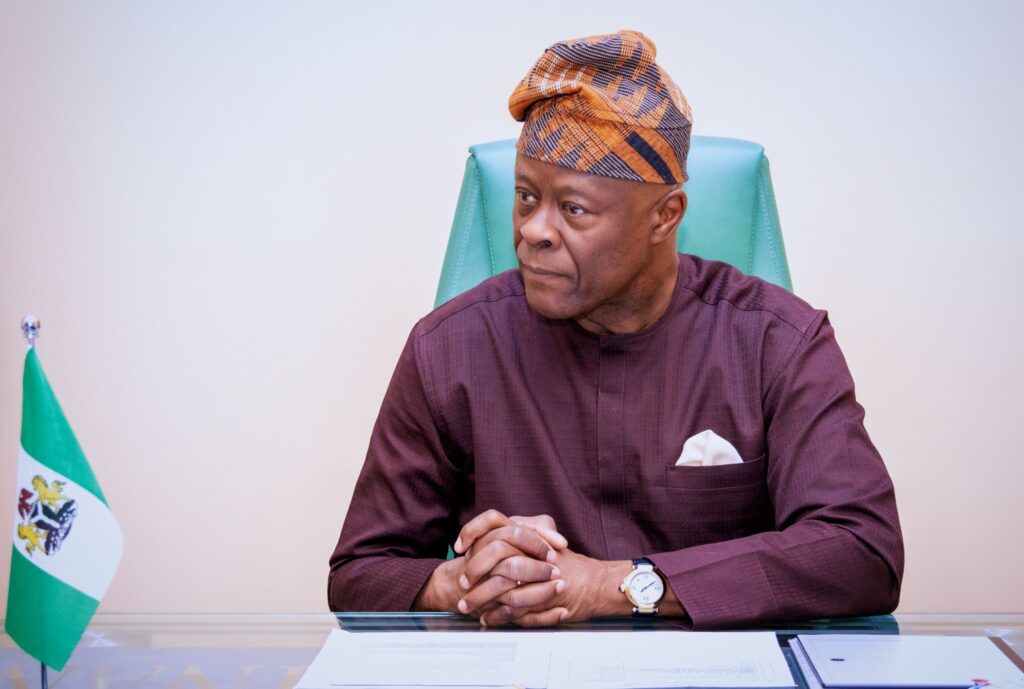
Redistributing unearned income was the stated goal behind the contentious windfall tax’s introduction in the banking sector, according to Mr. Wale Edun, Minister of Finance and Coordinating Minister of the Economy.
He added that the tax was “done everywhere else in the world where you have, especially the energy sector as well as banking,” proving that it was not unique to Nigeria. When the minister recently made an appearance on AIT’s Moneyline program, he provided the clarification.
He said, “Where you have unearned income, where you have a section of the society or an industry or a set of companies that earn money through no dint of hard work of their own.
“The society deserves a chance to share some of that and it’s just redistribution of that. So I think that takes care of the issue of the windfall levy.”
Additionally, Edun made it clear that the federal government does not generally rely on financing from the Central Bank of Nigeria (CBN) as a result of the recent decision to increase the maximum borrowing percentage in the Ways and Means from 5% to 10%.
He said that the government had managed its debts more effectively by using market tools.
The minister said, “We have not gone to the central bank to say, please lend the government money to pay its debt, to pay its salaries. That’s Ways and Means. We have not gone. In fact, we have used market instruments to pay down what we owed, and that is a very, very germane aspect of having a strong economy”.
He explained that the National Assembly’s approval was a safety precaution.
The minister said, “Sometimes it just gives that extra flexibility so that if a payment needs to be made and there’s a mistiming, there’s a gap between the time at which the revenue will come in and the expenses needed, you can just draw down briefly.
“So, the aim is to keep within the letter of the law, I think that’s the main point.”
He added that the current administration continues to place a high premium on the welfare of Nigerians, especially assuring the availability and affordability of food.
Edun said, “There is a concerted effort to ensure that we have homegrown food available. In the short term, apart from what is being distributed from reserves, there is a window that has been opened for importation because the commitment of Mr. President is to drive down those prices now and make food available now.”
He gave his word that the move wouldn’t hurt neighborhood farmers because imports would only be allowed once local resources were depleted.
He said, “So, one of the conditions for this importation will be that everything available locally in the markets or with the millers and so forth has been taken up. We will have auditors that will check that.”
According to him, the goal of these interventions is to stabilize the currency rate, cut interest rates, and lessen inflation in order to foster investment and employment growth.
According to him, “With the kind of food production programme we have, inflation will come down as prices come down. When inflation comes down, exchange rate will stabilise. Interest rates will come down and the economy will have a chance.
“People will have a chance at reasonable rates to invest in various sectors of the economy, increase productivity, grow the economy and create jobs which is the key to reducing poverty.”
The minister also discussed the government’s cash transfer program, which aims to assist the most vulnerable and impoverished residents. According to him, the initiative presently serves roughly 4.3 million people, and there are plans to quickly grow this number.
He said, “Right now it’s about 4.3 million. But the last million was in the last few weeks. And when I say we’re ramping at a rate of 1 million per month, that is an ongoing process.”
Depending on technology capabilities, he estimated that the initiative might grow to help one million individuals either every two weeks or every week.
On funding for economic initiatives, Edun said, “This particular money, $800 million, is under a World Bank programme. But it’s under an International Development Association (IDA) programme, and that money is for 40 years at one percent. So, if you say it is borrowing, well it is, but it is the softest and the cheapest and the most affordable form you can get. The rest will come from the Nigerian federal budget.”
He continued by saying that the government had created a number of support programs for different business sizes in an effort to boost production and combat inflation.
He stated that while small and medium-sized businesses can get N1 million in funding at a rate of 9% annually, nano firms will receive grants of N50,000. At the same interest rate, larger medium-sized businesses can receive up to N1 billion in funding.
According to him, fiscal policies and import waivers are being put in place to lower expenses for big corporations. One such policy is the removal of the withholding tax for small and medium enterprises.
He also discussed how the Ministry of Finance and the Debt Management Office had helped the Central Bank of Nigeria (CBN) control inflation during his speech on the coordination of fiscal and monetary policies.
According to him, “The government, through the Ministry of Finance and the Debt Management Office, took on the challenge of paying higher interest rates on our domestic debt so that we could help the central bank, one, achieve its inflation target, but more importantly, attract foreign flows into the country, which has helped the central bank to pay down virtually all of its outstanding foreign obligations.”
In addition, Edun explained that the N570 billion that was recently transferred to state governments was a repayment as per the COVID finance process.
The issue is that the states have received more money, he says. “This actually refers to a reimbursement that they received around December, from December last year onward. I believe it was a reimbursement under the COVID financing protocol.” They’ve gotten additional cash. We must conduct our own research.
