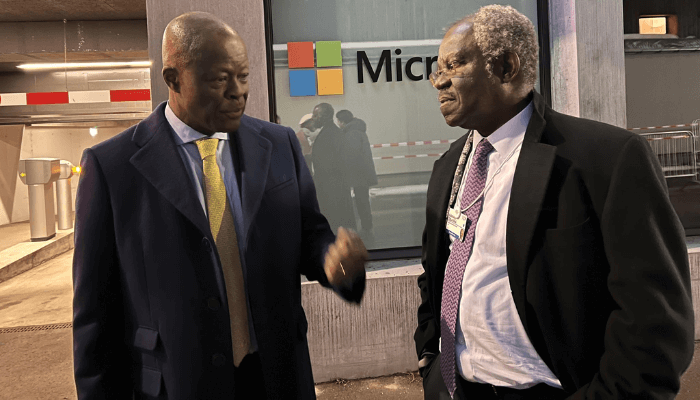
Wale Edun, Nigeria’s Minister of Finance and Coordinating Minister of the Economy, met with Adebayo Ogunlesi, a Nigerian-born private equity expert and newly appointed board member of OpenAI, during the World Economic Forum in Davos. Ogunlesi, renowned for his achievements in business and investment, joined OpenAI’s board shortly before the global event, attracting attention for his potential contributions to the future of artificial intelligence.
In an interview at Davos, Minister Edun outlined the federal government’s new economic priorities, emphasizing the need to optimize existing assets to generate funding.
Focus on Asset Optimization and Private Investment
Edun stated that Nigeria would no longer rely heavily on short-term financing from international institutions, as the country does not face balance of payments challenges. Instead, the government aims to maximize its assets and attract private sector savings and foreign direct investment.
“We have utilized multilateral and concessional financing as much as possible. Now, we need to optimize our assets, rely on equity, and attract savings from the private sector, both locally and internationally,” Edun said.
He further explained that the government had tapped into domestic savings by issuing bonds while presenting the President’s macroeconomic plan to highlight Nigeria’s potential for economic growth, business opportunities, and an improved investment climate.
Strong Trade Balance and Growing Reserves
Addressing the International Monetary Fund (IMF) financing, Edun emphasized that Nigeria does not require such assistance since it is typically meant for countries with short-term balance of payments crises. He pointed to Nigeria’s positive trade balance, current account surplus, and an increase of over $10 billion in foreign reserves, as recently announced by the Central Bank Governor.
Combating Inflation through Increased Supply
Edun acknowledged that high food inflation and cost of living remain pressing issues. While the Central Bank’s monetary policies, such as interest rate adjustments, play a role in curbing inflation, Edun stressed the importance of boosting supply.
“Increasing supply is critical. With efforts to support smallholder farmers through inputs like herbicides, fertilizers, and seeds, we are seeing better harvests. However, more needs to be done to improve food production, lower prices, and enhance affordability for Nigerians,” he said.
He added that this commitment to food security aligns with the government’s broader plan to grow the economy and reduce poverty.
Economic Reforms Yielding Positive Results
Edun highlighted that Nigeria’s economy is on a recovery path, with substantial reforms now delivering positive outcomes. “The economy is growing again, foreign reserves are increasing, and debt servicing as a percentage of revenue is decreasing. The deficit and debt-to-GDP ratio are also declining, creating a better investment environment,” he stated.
Investors Express Strong Interest in Nigeria
The Nigerian delegation, led by Vice President Kashim Shettima, engaged with businesses across various sectors at Davos. Edun reported that companies in financial payments, consumer goods, and other industries had expressed interest in investing billions of dollars in Nigeria, citing improved foreign exchange policies and a favorable investment climate.
He also highlighted ongoing bilateral meetings with potential investors, expressing optimism about their contributions to job creation, economic growth, and poverty reduction.
Resurgence in Oil and Gas Investment
Edun noted that Nigeria is once again the leading destination for oil and gas investment in Africa. “All 19 major sub-sectors of the economy are growing and improving. Both foreign and local investors are prepared to invest, signaling a positive outlook for Nigeria’s productivity and competitiveness,” he said.
Commitment to Social Safety Nets
The Minister reiterated the government’s commitment to supporting the most vulnerable through targeted interventions, including direct benefit transfers, to alleviate the cost of living.
“With sustained reforms, increased investment, and a commitment to reducing poverty, the future is bright for Nigeria,” Edun concluded.
Global Admiration for Tinubu’s Leadership
Edun also highlighted widespread recognition of President Bola Tinubu’s decisive actions, including removing fuel subsidies, which have boosted investor confidence and positioned Nigeria for a surge in domestic and international investments.
“The outlook is positive. The reforms and policies are setting the stage for long-term economic growth, job creation, and poverty reduction,” he said.
