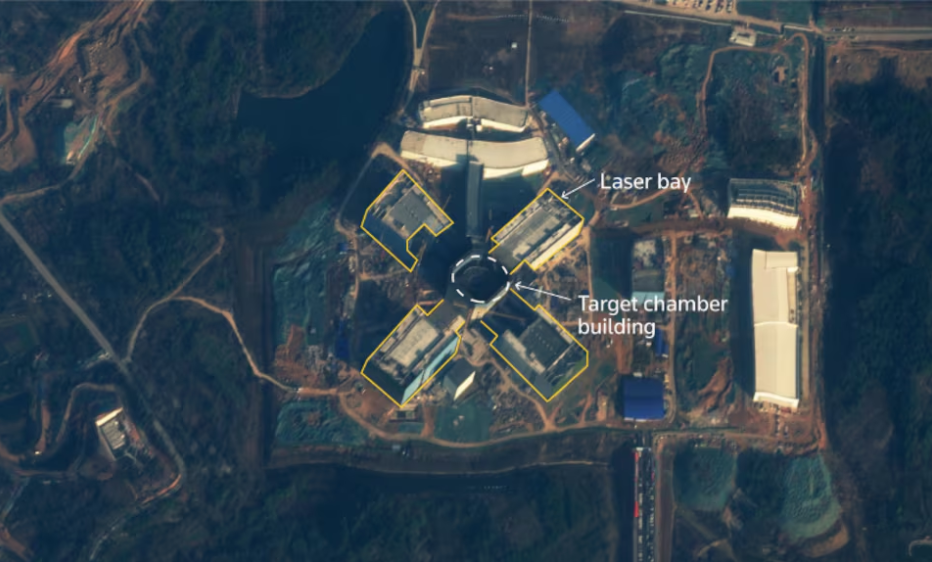
China appears to be constructing a massive laser-ignited fusion research center in Mianyang, a southwestern city known for its defense research, according to experts from two analytical organizations. This development could significantly impact nuclear weapons design and clean energy research.
Satellite images indicate that the facility includes four outlying “arms” designed to house laser bays and a central experiment bay. This bay will contain a target chamber where powerful lasers will fuse hydrogen isotopes, producing energy.
Decker Eveleth, a researcher at the U.S.-based CNA Corporation, revealed these findings, noting that the design closely resembles the $3.5 billion U.S. National Ignition Facility (NIF) in Northern California. In 2022, NIF made history by achieving “scientific breakeven,” generating more energy from a fusion reaction than was injected by the lasers.
Eveleth, who collaborates with analysts at the James Martin Center for Nonproliferation Studies (CNS), estimates that the experiment bay in China’s facility is approximately 50% larger than NIF’s—the current largest fusion facility in the world.
The development of this facility has not been previously reported. Experts believe such a center could enhance China’s nuclear capabilities without the need for actual nuclear tests.
“Any country with an NIF-type facility can and probably will be increasing their confidence and improving existing weapons designs while facilitating the design of future bomb designs without testing,” said William Alberque, a nuclear policy analyst at the Henry L. Stimson Center.
When approached for comments, China’s Foreign Ministry directed inquiries to the “competent authority,” while the Science and Technology Ministry did not respond. The U.S. Office of the Director of National Intelligence also declined to comment.
In November 2020, then-U.S. arms control envoy Marshall Billingslea released satellite images claiming China was expanding nuclear weapons support facilities, including a cleared plot in Mianyang. According to construction documents shared by Eveleth, this site is now home to the Laser Fusion Major Device Laboratory.
Laser-induced fusion works by using high-powered lasers to compress and heat fuel, triggering nuclear fusion. The process consists of four stages: heating, compression, ignition, and energy release.
Igniting fusion fuel allows researchers to study how these reactions occur and how they could eventually power a clean energy source using hydrogen—the universe’s most abundant element. It also provides insights into nuclear detonations without the need for live explosive testing.
Both China and the U.S. are signatories to the Comprehensive Nuclear Test Ban Treaty, which prohibits nuclear explosions in any environment. However, countries are permitted to conduct “subcritical” explosive tests, which do not trigger a nuclear reaction, and laser fusion research, known as inertial confinement fusion, is also allowed under the treaty.
Siegfried Hecker, a senior fellow at the Freeman Spogli Institute for International Studies and former director of the Los Alamos National Laboratory, emphasized that such experiments are essential for nations maintaining nuclear arsenals. However, he noted that countries like China—having conducted only 45 nuclear tests compared to the U.S.’s 1,054—may find such research less valuable due to their limited historical test data.
“I don’t think it would make an enormous difference,” Hecker said. “I’m not concerned about China getting ahead of us in terms of their nuclear facilities.”
Several other nuclear powers, including France, the United Kingdom, and Russia, also operate inertial confinement fusion facilities. The size of such facilities reflects the amount of power required to achieve ignition.
Omar Hurricane, chief scientist for inertial confinement fusion at Lawrence Livermore National Laboratory, explained that while modern facilities may be smaller and more efficient, reducing their scale too much could hinder experimental success.
“It’s kind of hard to stop scientific progress and hold information back,” Hurricane noted. “People can use science for different means and different ends, and that’s a complicated question.”
China’s development of a large-scale laser fusion research facility in Mianyang marks a significant advancement in nuclear research, with potential applications in both defense and clean energy. While experts debate its implications, the facility represents another step in the global race for nuclear and fusion technology advancements.