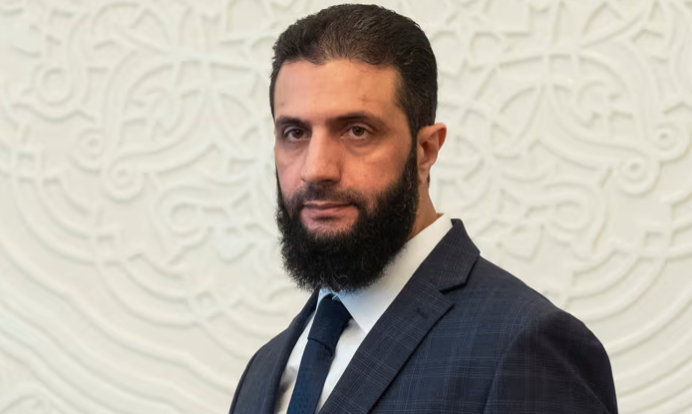
The former leader of Hayat Tahrir al-Sham (HTS), Ahmed al-Sharaa, has been appointed president of Syria for a “transitional period” following last month’s military operation that led to the ousting of former President Bashar al-Assad.
Sharaa, who has been the de facto leader since early December, was officially appointed after a meeting of rebel faction leaders on Wednesday. The announcement was made by a military spokesperson, who also outlined major political and security changes.
Sweeping Political and Military Reforms
The spokesperson declared the dissolution of Syria’s parliament and the formation of an appointed legislative council. Additionally, the country’s 2012 constitution has been annulled, and Syria’s military and security agencies have been disbanded to make way for new institutions.
A significant development is the decision to disband all armed factions in Syria, integrating them into the newly formed national army. While the directive did not explicitly mention HTS, the group remains the dominant power in the country.
Sharaa emphasized that his administration’s priorities include “filling the power vacuum, preserving civil peace, and building state institutions.”
Uncertain Transition Timeline
The transitional government is expected to transfer power to a new administration in March. However, the specifics of this transition remain unclear. In an interview with Al Arabiya last month, Sharaa suggested that holding elections could take up to four years, with a new constitution potentially taking three years to draft.
Although Sharaa has pledged to hold a national dialogue conference to ensure inclusivity in the post-Assad era, the event has faced multiple delays. His meetings so far have been primarily with individuals rather than established political parties.
Challenges in Consolidating Power
The dissolution of military factions remains a contentious issue. HTS, originally an offshoot of al-Qaida’s Syrian branch, became the country’s most formidable rebel group, leading the coalition that overthrew Assad. Its influence continues to shape Syria’s interim government.
The Syrian Ministry of Defence announced in mid-January that it would consult various factions on forming a unified military. However, this effort faces obstacles, particularly from more radical Islamist factions within the Turkish-backed Syrian National Army, which differ ideologically from HTS and lack its discipline.
Additionally, the abrupt fall of the Assad regime has resulted in widespread access to weapons, including tanks and artillery, some of which have fallen into rebel hands.
International Concerns and Foreign Relations
Restoring Syria’s state monopoly on force is seen as critical for maintaining internal stability. Foreign powers are closely monitoring the situation, wary of a potential descent into chaos reminiscent of Libya’s post-Gaddafi era, where warring factions led to widespread lawlessness.
The interim government has been actively seeking regional and international support to stabilize its fledgling state. Its first foreign engagements included visits to Saudi Arabia and Turkey, with key ministers advocating for diplomatic recognition and financial backing.
At the same time, negotiations with the US-backed Syrian Democratic Forces (SDF) continue. The Kurdish-led SDF, which controls a third of Syria, has requested military autonomy within the new Syrian army—an appeal that the transitional government has rejected. Meanwhile, clashes between the SDF and the Turkish-backed Syrian National Army have escalated in northern Syria.
As Syria navigates its uncertain future, the international community remains watchful, hoping for a stable transition but wary of further conflict.
