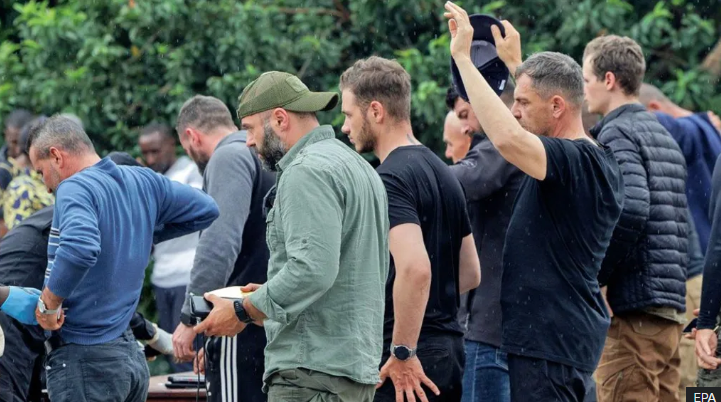
It has been a devastating week for nearly 300 Romanian mercenaries hired to fight alongside the Democratic Republic of Congo’s (DR Congo) army. Their surrender following a rebel assault on the eastern city of Goma has crushed their hopes of making lucrative earnings.
The BBC has reviewed contracts indicating that these hired soldiers were being paid around $5,000 (£4,000) per month, while regular Congolese military recruits earn approximately $100 or sometimes go unpaid. The Romanians were contracted to support the army in its battle against the Rwanda-backed M23 rebels, who claim to be fighting for the rights of DR Congo’s minority ethnic Tutsis.
When the offensive on Goma began Sunday night, the Romanian fighters sought refuge at a UN peacekeeping base.
“The M23 rebels were supported by troops and state-of-the-art military equipment from Rwanda and managed to reach our positions around the city of Goma,” said Constantin Timofti, identified as a coordinator for the group, speaking to Romania’s TVR channel on Monday.
“The national army gave up fighting, and we were forced to withdraw.”
Surrender and Public Humiliation
Romania’s foreign ministry spokesman, Andrei Țărnea, told the BBC that “complex” negotiations led to M23 handing over the Romanian fighters—whom he described as private employees of the DR Congo government on an army training mission—to Rwanda.
Goma, located on the border with Rwanda, became the stage for a public surrender. Journalists filmed the mercenaries crossing over, undergoing body searches, and other security checks.
Before the crossing, a phone recording captured M23 commander Willy Ngoma interrogating one of the Romanians in French, instructing him to sit on the ground with crossed legs and hands over his head.
When asked about his military background, the Romanian replied that he had trained with the French Foreign Legion.
“They recruited you with a salary of $8,000 a month. You eat well,” Ngoma remarked, contrasting their pay with that of Congolese soldiers.
“We are fighting for our future. Do not come here for adventure.”
Mercenary Contracts and Widespread Recruitment
The $8,000 figure cited by Ngoma remains unverified. A contract shown to the BBC by a former Romanian mercenary in October detailed a “strictly confidential remuneration” structure: $5,000 per month for active duty and $3,000 during leave periods.
The agreement outlined an indefinite period of service, with recruits scheduled for a one-month break after every three months of deployment.
During an investigation in Bucharest, the BBC uncovered that many of these mercenaries were associated with Asociatia RALF, a Romanian enterprise linked to ex-Romanian soldiers from the French Foreign Legion. It is headed by Horațiu Potra, a Romanian military instructor.
“When they arrived, everyone referred to them as Russian,” said Fiston Mahamba, co-founder of disinformation watchdog Check Congo.
“I think this was linked to the Russian mercenary group, Wagner, which operates in several African countries.”
The Scope of the Operation
Asociatia RALF appears to have a broad operational reach, with contracts spanning multiple African nations, including Burkina Faso, Ivory Coast, Niger, Senegal, Sierra Leone, Gambia, and Guinea.
In 2022, DR Congo brought in two private military companies to strengthen its forces:
- Agemira RDC – Led by French-Congolese national Olivier Bazin, employing Bulgarian, Belarusian, Georgian, Algerian, French, and Congolese personnel. This firm focused on refurbishing military air assets, rehabilitating airports, and securing strategic locations.
- Congo Protection – A Congolese firm represented by Thierry Kongolo, which signed a contract with Asociatia RALF to provide security training for Congolese troops.
“We have to protect ourselves. If M23 attacks us, they won’t simply say: ‘Oh, you’re just instructors—go home,’” Potra told the BBC in July.
Discontent and Deadly Consequences
A former mercenary who resigned over operational concerns described the mission as chaotic.
“Missions were disorganized, working conditions poor. Romanians should stop going there because it’s dangerous.”
He also revealed that some Romanian recruits lacked military experience, citing a former firefighter as an example.
DR Congo’s government has not responded to BBC inquiries regarding background checks or the pay disparity between private contractors and Congolese soldiers.
Among the casualties was Vasile Badea, a 46-year-old Romanian police officer on sabbatical, who took the job for its lucrative salary but was killed last February in an ambush by M23 fighters.
Expanding Recruitment Efforts
Despite the dangers, Romanian mercenaries continue to be recruited. In October, the BBC met a Bucharest-based recruiter who was seeking 800 new hires for deployment to Goma.
“We are very busy finding people who are mentally prepared and know how to fight,” the recruiter said, refusing to disclose his employer.
“Recruits will be placed according to their training, earning between $400-$550 per day.”
Recruitment remains highly confidential, primarily conducted through encrypted messaging apps like WhatsApp. One WhatsApp group reviewed by the BBC had over 300 Romanian members, many of them ex-military personnel.
Legal and Ethical Concerns
The presence of mercenaries in DR Congo has drawn international criticism. In June, Rwanda’s government spokesperson, Yolande Makolo, condemned their involvement, citing violations of the Geneva Conventions, which prohibit the use of hired combatants.
Congolese government spokesperson Patrick Muyaya dismissed Rwanda’s objections:
“We have instructors training our military forces because we have an urgent security situation.”
However, Congolese troops feel sidelined.
“The pay is unfair. We are sent to the front lines first, and they [the mercenaries] only come as backup,” a Congolese soldier told the BBC anonymously.
His base in Kibati was overrun by M23 last week, resulting in many fatalities, including his commander. He has not been heard from since.
A Fractured Defense Strategy
Analysts argue that DR Congo’s military strategy is failing due to fragmented command structures. The army operates alongside troops from the Southern African Development Community (SADC), local militias like Wazalendo, and Burundian forces.
“It’s impossible to plan military operations when command structures are so muddled,” said Richard Moncrief, Great Lakes project director at the International Crisis Group.
“A more coherent approach is necessary—likely involving fewer armed actors on the ground.”
For the ex-mercenary, the fate of his Romanian colleagues was inevitable.
“Poor command leads to failure.”
Final Thoughts
The fall of Goma is a stark reminder of the ongoing instability in North Kivu, fueled by mercenary involvement, militia conflicts, and mineral wealth. As the region remains a battleground, the future of foreign fighters—and DR Congo’s security—remains uncertain.
