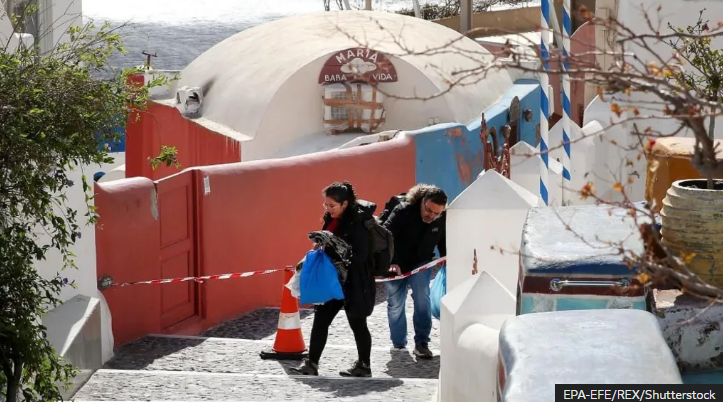
A powerful magnitude 5.2 earthquake has been recorded between the Greek islands of Amorgos and Santorini, following days of consecutive tremors in the region. The quake struck at 21:09 local time (19:09 GMT) at an estimated depth of 5 km.
Mass Evacuations from Santorini
In response to the seismic activity, over 11,000 people have left Santorini, with approximately 7,000 departing by ferry and 4,000 traveling by air. Although no major damage has been reported, authorities are implementing precautionary measures to ensure public safety.
Santorini, a world-famous tourist destination, is currently in its low season, meaning most of the evacuees are local residents and workers.
Schools Closed on Affected Islands
Schools on Santorini and neighboring islands—including Anafi, Paros, Naxos, and Mykonos—will remain closed until at least Friday, when officials will reassess the situation and decide on reopening.
Emergency Response and Government Action
Greek authorities have deployed emergency response units, including:
- Specialized firefighters trained for natural disasters
- Rescue teams with search dogs
- A mobile operations center
- Helicopters on standby for emergencies
Greek Climate and Civil Protection Minister Vassilis Kikilias confirmed that the coast guard and armed forces are also prepared to assist vulnerable residents who wish to evacuate.
Earlier on Wednesday, Greek Prime Minister Kyriakos Mitsotakis addressed civil protection experts with a reassuring message:
“First and foremost, the state trusts science and scientists. We have done this in other crises.”
“All plans have been implemented. Forces have been moved to Santorini and the other islands, so that we are ready for any eventuality,” Mitsotakis stated.
He urged residents to stay calm and cooperate with authorities as the situation continues to be monitored.
Santorini’s Volcanic and Seismic History
Santorini sits on the Hellenic Volcanic Arc, a chain of islands shaped by volcanic activity. However, the last major volcanic eruption occurred in the 1950s. Scientists confirm that the recent tremors are due to tectonic plate movements, not volcanic activity.
While earthquake prediction remains impossible, experts can identify high-risk zones, allowing governments to better prepare for potential seismic events.
The Greek islands, including Santorini, are situated near a tectonic plate boundary, where earthquakes are more frequent due to shifting geological forces.
With continued monitoring and emergency preparedness, authorities are focused on ensuring public safety and minimizing disruptions. Further updates will follow as the situation develops.
