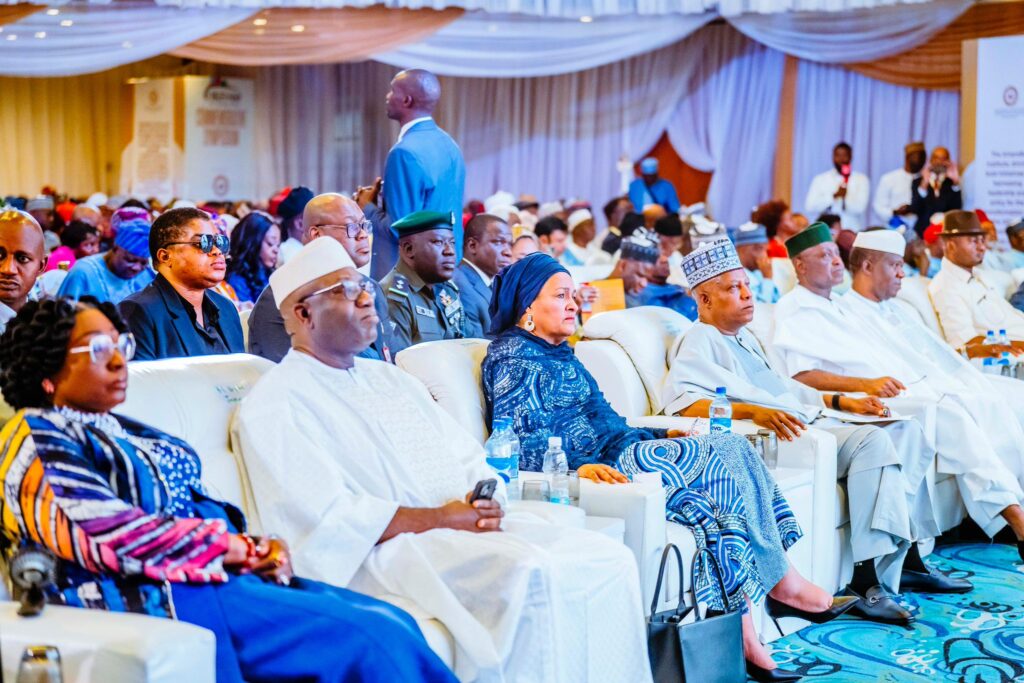
President Bola Ahmed Tinubu has urged African leaders to abandon their reliance on foreign development plans and embrace homegrown policies that drive real progress. Speaking at the Dr. Kayode Fayemi Commemorative Symposium and the launch of the Amandla Institute for Policy and Leadership Advancement in Abuja, Tinubu stressed the need for visionary leadership that prioritizes execution over rhetoric.
Represented by Vice President Kashim Shettima, Tinubu lamented what he described as “the tragedy of our time,” where African leaders remain trapped in client-state mentalities and governance driven by hashtag activism instead of bold policy decisions.
“The world is not waiting for Africa to catch up. While we parse political rivalries, others parse datasets. While we litigate history, others engineer futures. The train of progress accelerates, yet too many of our leaders cling to old carriages,” he said.
Tinubu emphasized that Africa’s development will not come as a gift but must be built, warning that for too long, leaders have outsourced their thinking to foreign institutions that treat the continent as mere consumers rather than creators. He called for investment in local tech hubs from Cairo to Lagos, fostering innovation without reliance on external gatekeepers.
Amandla Institute as a Solution
He hailed the launch of the Amandla Institute as an antidote to Africa’s policy paralysis, urging it to transform thinkers into doers and policies into progress.
“We need leaders who wield policy as a scalpel, not a slogan. We need visionaries who see AI as a collaborator, not a competitor. Pan-Africanism must be rooted in actionable sovereignty,” Tinubu said.
The President also challenged African governments to integrate AI strategists into ministries and develop homegrown trade policies rather than relying on foreign consultants. He envisioned a future where “Made in Africa” represents algorithms, green technology, and cultural capital, not just raw materials.
Mbeki Calls for Stronger African Leadership
Delivering the keynote address, former South African President Thabo Mbeki highlighted Africa’s repeated failures to achieve its development targets, citing poor leadership and weak resource mobilization as major setbacks.
He urged leaders to prepare for a global multipolar order, where Africa must position itself strategically to influence global decisions rather than merely reacting to them.
“Our continent must develop the right leadership capable of defending and advancing our vast interests within the context of competing global players,” Mbeki stated, expressing optimism that the Amandla Institute will help shape Africa’s future.
Dignitaries in Attendance
The event attracted top African leaders and dignitaries, including UN Deputy Secretary-General Amina Mohammed, former Nigerian Head of State Gen. Yakubu Gowon, former Vice President Atiku Abubakar, former Senate President Bukola Saraki, and several serving and former governors and policymakers.
Africa Seeks Collaboration, Not Patronage
Concluding his remarks, Tinubu charged African youth to leverage modern technology to “leapfrog colonial legacies”, calling on Amandla to promote Africa’s self-reliance on the global stage.
“Africa seeks collaboration, not patronage. We are not a testing ground for experiments but equals in co-creating solutions. It’s time for Africa to stop debating ideas and start deploying them,” he declared.
