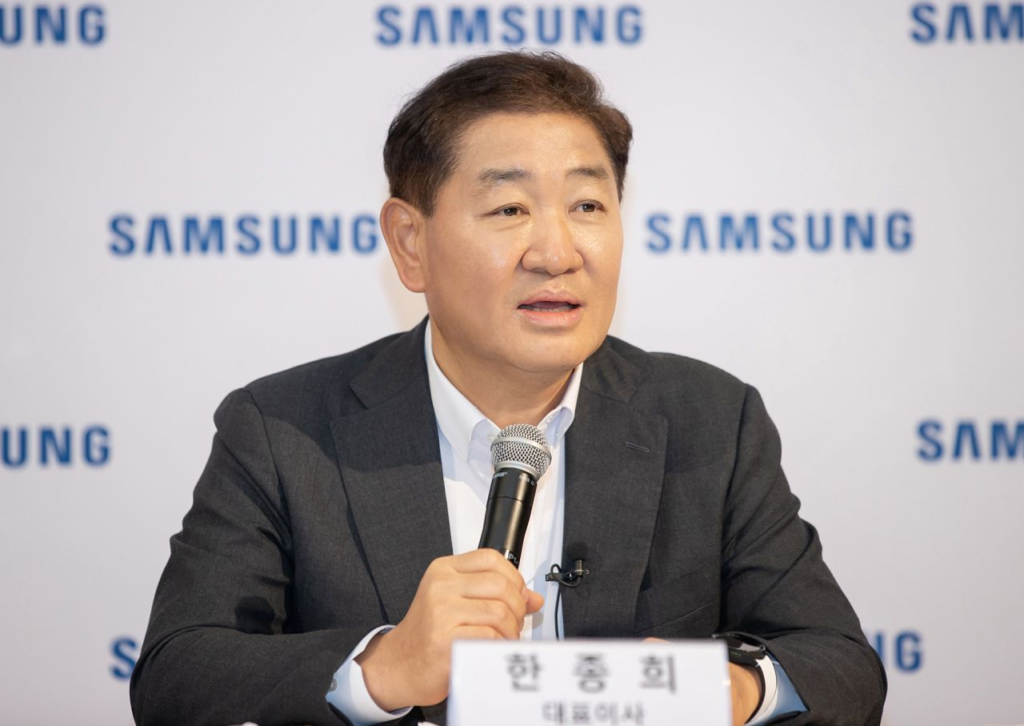
Samsung Electronics’ co-CEO, Han Jong-Hee, renowned for elevating the company’s global television business, has passed away at 63 after suffering a heart attack, the company confirmed on Tuesday.
“He died from cardiac arrest today,” a Samsung spokesperson told AFP, adding that he is survived by his wife and three children.
A Legacy of Innovation in Samsung’s TV Business
Han joined Samsung Electronics in 1988 and played a crucial role in propelling its high-end TV technology to global recognition.
“Han was central in the unveiling of Samsung’s world-class LED TVs,” the company stated in a biography published earlier this month.
Recognized for his numerous technological innovations, Han helped position Samsung as the global leader in television manufacturing, maintaining its dominance in the competitive market.
Samsung Electronics is the flagship subsidiary of the Samsung Group, South Korea’s largest family-controlled conglomerate, with Lee Jae-Yong as the company’s current chief.
Impact on Samsung’s Global Strategy
Han’s passing is expected to have a significant impact on Samsung’s strategic direction, particularly in the TV market, said Kim Dae-Jong, a business professor at Sejong University in Seoul.
“Considering he has been deeply involved in Samsung’s TV business for decades, helping it firmly secure its global standing, his absence could affect its global strategy for years to come.”
Samsung, alongside competitors LG and TCL, has been integrating AI-powered features into its television lineup, transforming screens into intelligent digital assistants capable of interacting with users and smart home devices.
Samsung Faces AI and Semiconductor Challenges
Han’s death comes at a crucial time for Samsung, as the company navigates significant challenges in the AI-driven semiconductor market.
Despite being the world’s largest memory-chip maker, Samsung has struggled to meet rising AI chip demand, particularly from Nvidia, while local rival SK Hynix has emerged as Nvidia’s top supplier of high-bandwidth memory (HBM) chips.
Recognizing the urgency, Samsung Electronics chairman Lee Jae-Yong recently emphasized the need for a “do-or-die” approach to maintain the company’s technological edge.
At Samsung’s recent shareholders’ meeting, which was Han’s last public appearance, he highlighted the company’s push for new growth opportunities.
“We will continue to pioneer in various areas such as robotics, medtech, and next-generation semiconductors to secure new growth momentum,” Han said at the meeting.
Samsung’s operating profit declined by nearly a third in Q4 2024, largely due to increased investment in AI and semiconductor research.
The global tech industry remains shaken by the emergence of DeepSeek’s new R1 chatbot, which has disrupted AI markets and raised concerns about the sustainability of massive AI investments.
