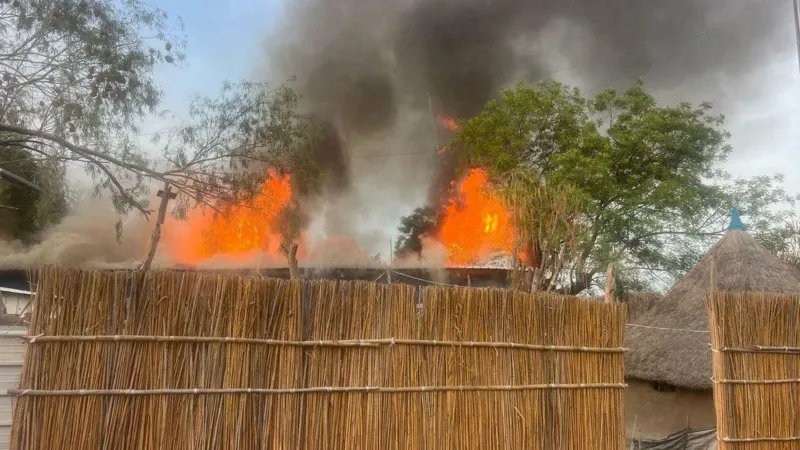
At least seven people have been killed in an aerial bombing that struck a hospital and local market in Old Fangak, located in Fangak County, Jonglei State, South Sudan. The incident has raised fresh fears of an impending return to civil war in the country.
The international medical humanitarian organization Médecins Sans Frontières (MSF), also known as Doctors Without Borders, reported that helicopter gunships dropped a bomb on the pharmacy of the only hospital it operates in the region—completely destroying the building and all medical supplies. This was followed by a 30-minute attack on the town, and a subsequent drone strike on a local market.
“The hospital is clearly marked as ‘hospital’ with our logo,” MSF spokesman Mamman Mustapha told the BBC’s Newshour. “We have shared also our coordinates for all the warring parties in the area so the hospital should be known to both parties as a hospital.”
MSF condemned the attack as a “clear violation of international humanitarian law”, reporting that more than 20 people were injured in the incident. The hospital served over 110,000 people in the remote Fangak County, and its destruction leaves the community without critical medical care.
While local witnesses claimed the attack was carried out by “government forces helicopters,” there has been no official response yet from South Sudan’s government. The BBC says it has contacted the Ministry of Foreign Affairs for comment.
Rising Tensions in South Sudan
This deadly bombing comes amid escalating tensions between President Salva Kiir and Vice-President Riek Machar. In recent weeks, UN Special Representative Nicholas Haysom warned that South Sudan is “teetering on the brink of a return to full-scale civil war.”
Just hours before the bombing, Army Chief Paul Majok Nang vowed punitive military actions following the hijacking of river barges—blaming the attacks on a militia allegedly linked to Machar, who has not publicly responded.
Machar was arrested in March alongside several allies and accused of attempting to incite rebellion. The government has since listed several counties as “hostile,” believed to be aligned with his camp, raising fears of renewed ethnic and political violence.
Background on South Sudan’s Fragile Peace
Since gaining independence from Sudan in 2011, South Sudan has faced prolonged instability. A devastating civil war broke out in 2013, resulting in around 400,000 deaths and displacing 2.5 million people. Though a peace agreement was signed in 2018, the country’s political divisions remain unresolved.
The peace accord aimed to dissolve militias and create a unified national army, but many armed groups still pledge loyalty to rival political factions. Elections that were expected after the peace deal have yet to take place, deepening mistrust and uncertainty.
Earlier this year, clashes between the White Army militia, once allied to Machar, and government forces in Upper Nile State triggered renewed violence. In March, a UN helicopter evacuation operation came under fire, killing several, including a high-ranking general.
Rights groups and humanitarian organizations are now urging an immediate halt to bombings in civilian areas and calling for adherence to international humanitarian law.