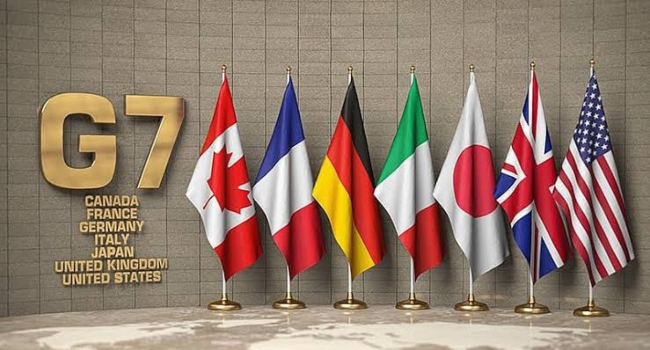
Finance ministers and central bank governors from the Group of Seven (G7) nations gathered in Banff, Alberta, this week for critical talks shaped by ongoing global uncertainties. At the forefront of discussions are the war in Ukraine and the economic fallout from U.S. President Donald Trump’s aggressive tariff policies, which have unsettled alliances and global markets.
The meeting, spanning Tuesday through Thursday, brings together representatives from Britain, Canada, France, Germany, Italy, Japan, and the United States. Ukrainian Finance Minister Sergii Marchenko also joins the summit, highlighting the group’s focus on Ukraine following Russia’s invasion in 2022.
Amid an increasingly unpredictable international landscape, the G7’s approach to the Ukraine conflict is less unified than in previous years. The Trump administration’s recent overtures to Russia and its sweeping tariffs—imposed on both allies and rivals—have complicated the alliance’s cohesion. After a phone call with Russian President Vladimir Putin on Monday, Trump claimed that Russia and Ukraine were set to initiate peace talks.
Sources close to the U.S. delegation confirmed that Washington is unlikely to issue a joint communique “just for the sake of doing a communique,” signalling that any consensus must align with the Trump administration’s priorities.
Canada’s Prime Minister Mark Carney, who invited Ukrainian President Volodymyr Zelensky to the upcoming G7 summit in June, is expected to engage with Ukraine’s Marchenko during the meeting. Meanwhile, U.S. Treasury Secretary Scott Bessent aims to “get the grouping back to basics and focused on addressing imbalances and non-market practices in both G7 and non-G7 countries,” according to a U.S. Treasury spokesperson.
A source privy to the discussions expressed particular concern over China’s excess industrial capacity flooding global markets, noting it as a key agenda item. This reflects the broader G7 focus on trade imbalances and economic security.
Despite efforts to tackle major challenges including trade, security, and climate change, experts warn that internal tensions, especially stemming from U.S. tariff measures, may hinder the G7’s effectiveness.
‘Elephant in the Room’
“This is an unusual G7,” remarked Ananya Kumar, deputy director at the Atlantic Council. She noted that the economic repercussions of Trump’s tariffs have cast a shadow over traditional G7 priorities, such as sanctioning Russia.
In recent months, the Trump administration has imposed a blanket 10 percent tariff on most U.S. trading partners and threatened further increases targeting the European Union and others. Additional tariffs on steel, aluminium, and automobiles have raised tensions with G7 countries, leaving the future of trade agreements uncertain.
The International Monetary Fund recently downgraded its global growth forecast, citing these tariffs as a major factor. Economies like Canada are expected to face significant negative impacts.
Kumar described the tariffs as “an elephant in the room,” adding, “I think a possible metric for success is that the U.S. wants to engage and negotiate a trade deal with these countries.”
While officials do not expect new trade deals to be announced at this week’s meeting, they acknowledge progress in ongoing negotiations. The Banff talks are viewed as a vital opportunity to find common ground.
Treasury Secretary Bessent, who played a key role in easing escalating tariffs with China, has been praised as “the adult in the room,” according to Carl Weinberg, chief economist at High Frequency Economics. Yet Bessent remains “under pressure from the Trump administration to deliver the agenda,” Weinberg said.
Advancing trade discussions is seen as pivotal for progress on other fronts, Kumar added. She also expects G7 members to reaffirm “commitment towards the status quo with Ukraine.”
Canadian Finance Minister Francois-Philippe Champagne will co-chair sessions on global economic resilience, security, and the ongoing situation in Ukraine. The summit will also include discussions on financial crime and the emerging role of artificial intelligence.
