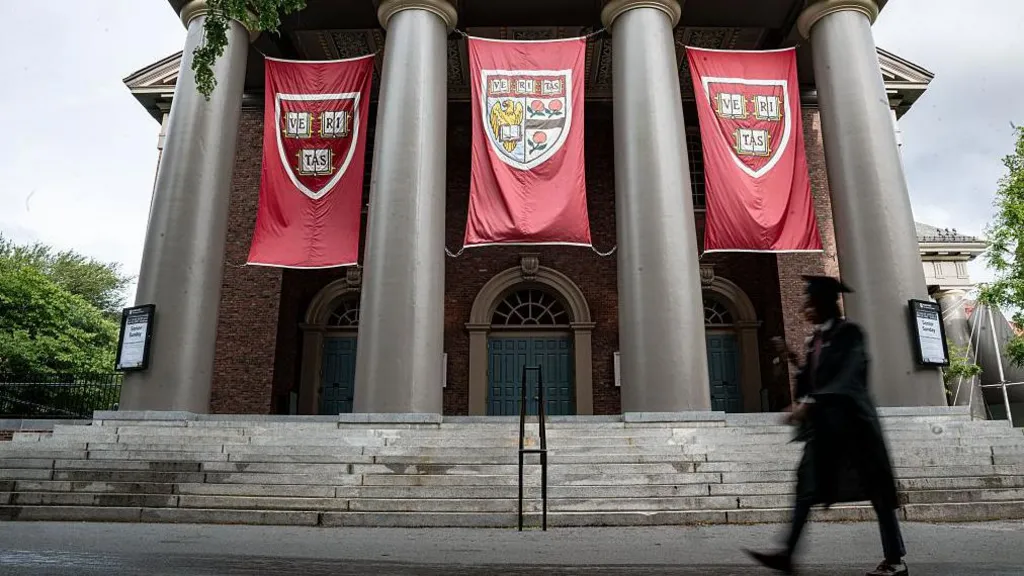
Harvard University is bracing for a new challenge from the Trump administration, which has initiated a review of the institution’s federal funding. The White House is focusing on approximately $100 million in government contracts awarded to Harvard, amid a larger battle that has intensified over recent months.
A senior White House official revealed that the Government Services Administration (GSA) plans to circulate a letter to federal agencies. The directive will ask agencies to evaluate whether Harvard’s grants should be “cancelled or redirected,” with a focus on contracts worth around $100 million, spread across an estimated 30 agreements.
The latest move adds to a growing list of actions against Harvard. Earlier, the administration froze $2.65 billion in federal grants and moved to revoke the university’s ability to enrol international students. The university did not immediately comment on the review.
Harvard’s Role in Critical Research at Risk
Harvard, America’s oldest university, has long been a recipient of federal funding for its groundbreaking research. According to Harvard’s official website, its work in areas such as cancer, heart disease, obesity, and infectious diseases has historically been supported by the federal government. Without these funds, the university warns that its scientific advancements could grind to a halt.
“Without federal funding, this work will come to a halt midstream,” the university’s website states, underscoring the potential impact on ongoing research projects.
Discrimination and Antisemitism Allegations Fuel Tensions
The latest review comes amid mounting tensions, with the Trump administration accusing Harvard of engaging in discriminatory practices. The draft of the GSA’s letter cites allegations of antisemitism, adding a controversial layer to the already fraught relationship between the two institutions.
Harvard students and faculty have been vocal in their criticism of the administration’s actions. Jacob Miller, a former head of Harvard Hillel, described the administration’s accusations as “absurd,” calling the justification for the funding cuts “an excuse to target the university.”
However, White House officials have stated that the cuts will not affect hospitals affiliated with Harvard, and that federal agencies can make the case to preserve critical funding where necessary.
Impact on Research Labs and Graduate Students
One key area affected by the funding freeze is Harvard’s Sinclair Lab at the Medical School. The lab, which conducts research into aging and diseases such as Alzheimer’s and multiple sclerosis, has already suffered losses, including a key National Institutes of Health grant. Researcher Kelly Rich, who focused on age reversal therapies, also lost her career grant.
David Sinclair, the lab’s founder, emphasized the far-reaching consequences of these cuts. “The loss of funding not only halts ongoing experiments but also jeopardizes the contributions of international scholars, whose work is vital to the lab’s operations,” Sinclair explained.
The potential impact on graduate students is also a major concern. Adam Nguyen, a Harvard alumnus, warned that the cuts could have a devastating effect on students who rely on external funding for their research. “If you have the cuts, they’re out of a job,” Nguyen stated, highlighting the immediate consequences for those dependent on the university’s research projects.
Political and Legal Battles Escalate
This is not the first time the Trump administration has clashed with Harvard. In April, the White House threatened to revoke the university’s tax-exempt status and froze $2.2 billion in grants. A subsequent lawsuit followed. In May, the administration attempted to block Harvard’s ability to enrol international students, which led to mass confusion and another lawsuit. A judge later issued a temporary restraining order blocking this move.
Alan Garber, President of Harvard, appeared on NPR to discuss the broader implications of the funding cuts, stressing the importance of federal research funding. “Sure, it hurts Harvard, but it hurts the country,” Garber remarked, underlining the collaborative nature of research and its national importance.
As Harvard’s leadership and its supporters brace for the outcomes of this new review, the university’s future relationship with federal funding remains uncertain, with significant consequences for both its academic community and the country’s research agenda.
