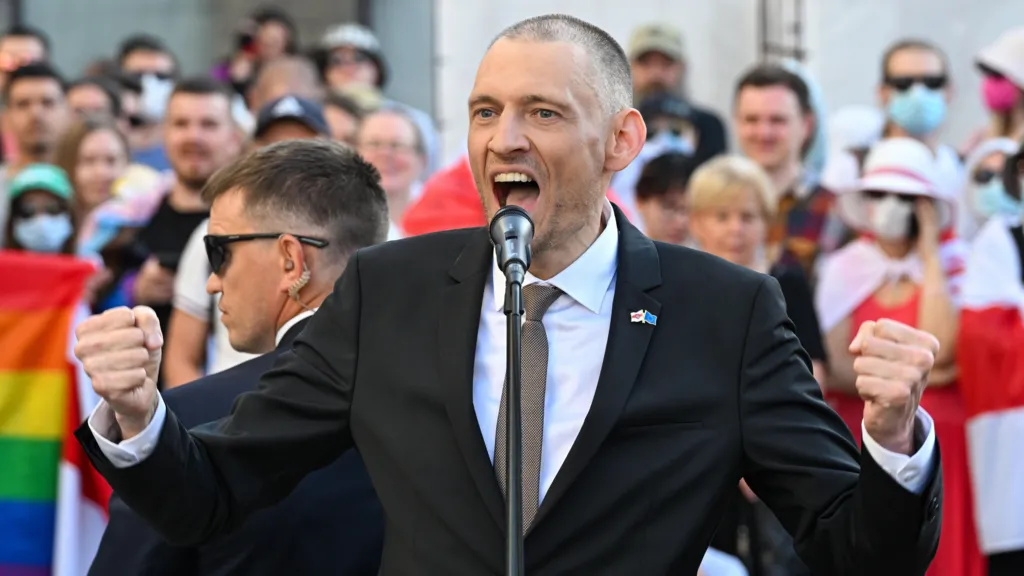
After five harrowing years in Belarus’ high-security prison system, opposition figure Sergei Tikhanovsky is finally free, but not without the physical and emotional scars left by his prolonged confinement. Tikhanovsky, a prominent Belarusian blogger and political dissident, was arrested ahead of the 2020 presidential election, where he had intended to run against the long-time dictator Alexander Lukashenko.
Upon his release last week, Sergei’s transformation was stark. Once a bearded, stocky figure, he now appears gaunt, his face drawn and eyes hollow. The weight loss is striking, as he claims to have shed almost 60 kilograms (132 pounds) while in solitary confinement. “Physically, I’m half the size and half the weight,” he said, his voice unsteady as he spoke of his years behind bars. “But my spirit is not broken. Maybe it’s even stronger.”
Tikhanovsky’s emotional release came as a result of rare international pressure. A visit to Belarus by a senior US delegation, led by special envoy Keith Kellogg, played a pivotal role in securing the release of Tikhanovsky and 13 other political prisoners. As Sergei recalls, his first moments with his family were emotionally charged, especially when he saw his daughter, who had been only four years old when he was arrested. “She didn’t recognise me,” Sergei admits, fighting back tears. “Then she threw herself into my arms and we hugged for a long time.”
For Tikhanovsky, the hardest part of his imprisonment wasn’t the physical deprivation, but the isolation. “When you can’t say or write anything, you can’t talk to anyone, and you’re just trapped in a cell – that’s the toughest thing,” he confided. The man who once led vocal protests against Lukashenko’s regime was denied contact with anyone for years, including his own family.
In prison, Sergei faced cruelty reserved for political prisoners. With little explanation, he was repeatedly sent to punishment cells for trivial reasons – a mark on the wall or even a cobweb. These small, cramped spaces were devoid of basic amenities, forcing him to keep warm by performing sets of squats and sit-ups throughout the night. “Those cells could be three-by-two metres, including a hole in the floor for a toilet,” he recalled. “No mattress, no sheet and no pillows.”
His emotional state deteriorated as his isolation continued. For almost three years, Sergei received no letters, phone calls, or any form of communication. “They would say: ‘You will die in prison,'” Sergei added. “We are going to keep extending your time and you won’t get out.”
Despite this, Sergei remained resolute. “I am no criminal,” he said, rejecting the idea of writing to Lukashenko to ask for a pardon. “That would be a betrayal of all who support me.”
Though Sergei had hoped for a release long before, it was not until August of the previous year that any hope seemed realistic. That’s when Belarusian authorities began encouraging political detainees to appeal for clemency, but Sergei, among others, remained off the list. However, last week, as part of an unexpected diplomatic exchange, Sergei was finally freed.
Belarus’ leader, Alexander Lukashenko, who has been internationally condemned for his crackdown on opposition and support for Russia in the Ukraine conflict, appeared to use the release of prisoners as a diplomatic gesture to improve relations with the West. For Sergei, this was a cynical move on Lukashenko’s part, a bid for a return to legitimacy. “For Lukashenko, this was the price of dialogue with the US,” Sergei remarked. “Because no one had been engaging with him before.”
The release of Sergei is bittersweet. While he is reunited with his family, many of his comrades remain behind bars. There are still over 1,000 political prisoners in Belarus, and Sergei has vowed to continue fighting for their freedom. He says he would “give anything” to secure their release.
Sergei’s wife, Svetlana Tikhanovskaya, who ran in his place during the 2020 elections and is now a leading opposition figure, has welcomed him home with open arms. However, she remains wary of the West’s next steps. “We cannot soften the sanctions until repressions fully stop,” she argues, underscoring that for every political prisoner freed, another is arrested. “For 14 people released, 28 more were detained immediately in Belarus.”
In his first week of freedom, Sergei has spoken publicly, met with politicians, and expressed gratitude for the support he received, including from former US president Donald Trump. However, despite his personal anguish and loss of time, his focus remains on his larger goal: the restoration of democracy in Belarus. “I don’t need any claim to her role,” Sergei said of his wife. “I just need a democratic Belarus.”
As Sergei Tikhanovsky begins to rebuild his life, he continues to draw strength from the profound sense of injustice he experienced behind bars. His fight against a brutal regime is far from over.
