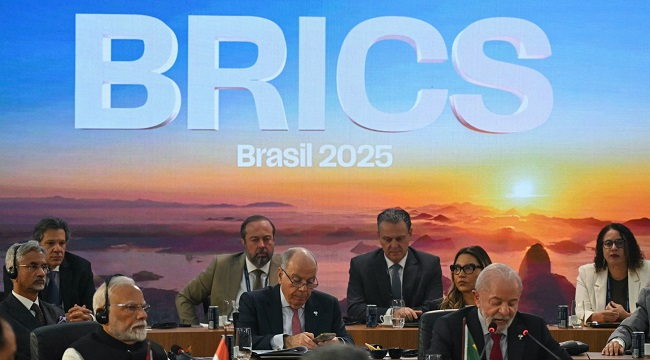
BRICS leaders at their summit in Rio de Janeiro have issued a strong rebuke against U.S. President Donald Trump’s controversial trade tariffs and recent military strikes on Iran, highlighting growing tensions within global geopolitics.
The bloc, which comprises Brazil, Russia, India, China, and South Africa, along with seven other emerging nations, represents approximately 40% of the global economy and half of the world’s population. Despite their internal differences, these nations found a shared stance on two critical issues: Trump’s tariff policies and the ongoing conflict in the Middle East.
In their joint statement, BRICS expressed “serious concerns about the rise of unilateral tariff measures,” denouncing Trump’s approach as detrimental to global economic stability. While the statement did not directly name the U.S. President, it warned that his tariffs risk exacerbating economic instability across the world.
“These tariffs are illegal and unfair, and they hurt global economic growth,” the summit declaration stated, emphasizing the potential harm such trade wars could inflict on developing nations. BRICS leaders have long criticized Trump’s trade strategy, particularly his erratic approach to tariffs that often target both allies and adversaries.
In response, Trump retaliated via social media, declaring, “Any country aligning themselves with the anti-American policies of BRICS will be charged an ADDITIONAL 10% Tariff. There will be no exceptions to this policy,” a comment that sparked further discord between the U.S. and the BRICS bloc.
The summit also voiced strong condemnation of recent Israeli and U.S. military actions against Iran, marking another point of contention between the BRICS and the U.S. The alliance, which includes Iran as a member since 2023, condemned airstrikes on Iranian nuclear facilities and other sensitive sites.
The BRICS bloc called for an “immediate” ceasefire and the full withdrawal of Israeli forces from Gaza, urging international actors to push for a peaceful resolution to the Israeli-Palestinian conflict, despite the varying positions of its members. Iran, which has consistently advocated for the dissolution of Israel, found itself diplomatically cautious but did not reject the summit’s declaration outright.
As the BRICS nations gather strength, their challenge lies in reconciling internal divisions, such as Iran’s position on Israel and Saudi Arabia’s reliance on U.S. military support. In a notable absence, Saudi Arabia’s foreign minister did not attend the summit, highlighting the delicate balancing act the bloc must maintain to preserve unity.
The absence of two key leaders—Chinese President Xi Jinping and Russian President Vladimir Putin—further underscored the complexity of the summit’s proceedings. Xi’s absence was particularly conspicuous, marking his first absence after 12 years in power. Putin, facing international war crimes charges, participated remotely.
Nevertheless, the summit agreed on the need for stronger regulations governing artificial intelligence (AI), underscoring the technology’s potential to bridge global inequalities. As the AI sector is currently dominated by U.S. tech giants, BRICS nations have emphasized the importance of ensuring that AI development is accessible to all nations, regardless of economic status.
The BRICS bloc continues to evolve, striving to be a counterbalance to the U.S. and Western European powers. As global tensions simmer, the coming months will reveal whether these emerging nations can find common ground on complex geopolitical issues or whether their internal differences will hamper their collective progress.
