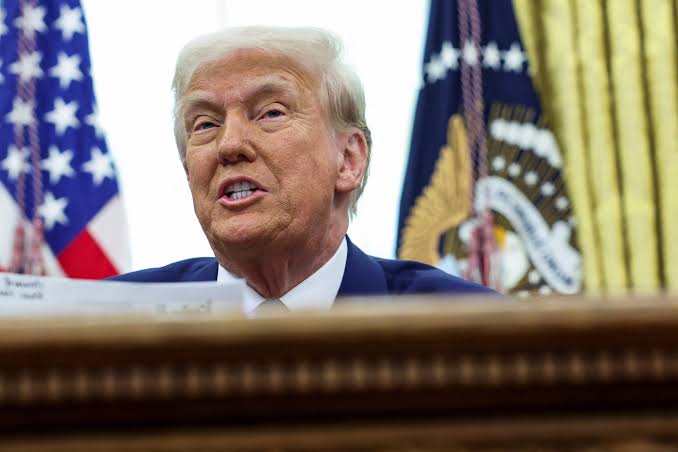
Nigeria’s already fragile economy may be headed for deeper trouble following a threat by United States President Donald Trump to impose an additional 10 per cent tariff on countries aligning with BRICS — the bloc of emerging economies led by Brazil, Russia, India, China, and South Africa.
In a post on his Truth Social platform on Sunday, Trump declared:
“Any Country aligning themselves with the Anti-American policies of BRICS will be charged an ADDITIONAL 10% Tariff. There will be no exceptions to this policy.”
The threat comes amid Nigeria’s growing involvement in BRICS activities. Although not a full member, Nigeria was formally admitted in January 2025 as the ninth partner country — a newly created category that allows participation in BRICS meetings, summits, and initiatives, short of full voting rights.
President Bola Tinubu is currently attending the 17th BRICS Summit in Rio de Janeiro, Brazil, at the invitation of Brazilian President Luiz Inacio Lula da Silva. His presence underscores Nigeria’s deeper integration with the bloc, which now includes 11 member states, following the 2024 addition of Egypt, Ethiopia, the UAE, Iran, Saudi Arabia, and Indonesia.
Tensions escalated after BRICS leaders condemned U.S. trade practices and recent military strikes involving Israel and Iran, describing Trump’s unilateral tariffs as “indiscriminate” and harmful to global economic stability. In a joint summit communiqué, BRICS nations raised “serious concerns about the rise of unilateral tariff measures.”
Trump responded forcefully on social media Sunday night, reiterating his intent to penalize any nation seen to be cooperating with BRICS. The announcement reignites concerns among analysts and business leaders in Nigeria about the impact on trade relations with the U.S.
Since 2023, Nigeria has battled severe economic turbulence marked by inflation, foreign exchange volatility, and fiscal tightening. Headline inflation soared from 18.85% in 2022 to 28.92% by the end of 2023 and peaked at 34.2% in June 2024 before moderating to 27.5% in mid-2025, according to data from the Central Bank of Nigeria (CBN).
While the CBN has tried to rein in inflation through monetary tightening — including the floating of the naira and removal of fuel subsidies — Nigeria’s economy remains heavily reliant on crude oil exports, leaving it highly vulnerable to global demand shifts and geopolitical risks.
An extra 10 per cent U.S. tariff on BRICS-aligned nations could hit Nigeria particularly hard. Over 90% of Nigeria’s exports to the United States are crude oil and petroleum products. Non-oil exports — including fertilisers, agricultural commodities, and manufactured goods — account for a small but growing segment of trade. Analysts warn that the proposed tariff could stifle Nigeria’s efforts to diversify its export portfolio and attract foreign investment.
Economic analyst Chidi Okonkwo, speaking to Channels Business News, warned that the threatened tariff could “further complicate Nigeria’s macroeconomic recovery.”
“Nigeria is in a delicate position. While its BRICS alignment offers long-term strategic benefits, a trade war with the U.S. would mean reduced export competitiveness and dampened investor confidence.”
Others argue that Nigeria must weigh the risks of geopolitical alignment with BRICS against its strong bilateral ties with the U.S., which remains one of its top trading partners.
President Tinubu’s administration has yet to issue an official response to Trump’s threat. However, senior diplomatic sources confirm that the Ministry of Trade and Investment is “reviewing potential scenarios” and considering measures to mitigate any fallout.
With Trump also giving an August 1 ultimatum for countries to make “deals” or face unilateral trade penalties, Nigeria faces a critical foreign policy balancing act — seeking the benefits of BRICS partnership without alienating powerful Western partners like the United States.
As Nigeria navigates this uncertain terrain, the prospect of punitive U.S. tariffs adds another layer of pressure to an economy already strained by inflation, subsidy reforms, and oil dependency
