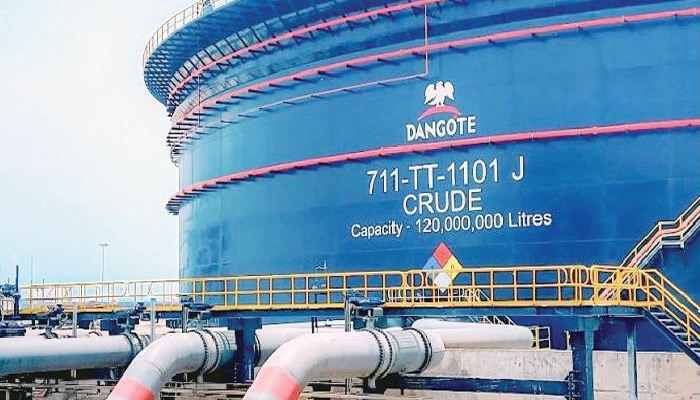
The Dangote Oil Refinery is set to lift 10 cargoes of crude oil from the Nigerian National Petroleum Company Limited (NNPC) between July and August 2025, according to a report by Bloomberg. This move signals the refinery’s accelerating shift towards full reliance on Nigerian crude, with plans to completely halt imports of foreign crude by December 2025.
Each of the 10 scheduled cargoes contains nearly one million barrels, amounting to approximately 10 million barrels in total. Five shipments are expected in July, with another five slated for August.
This marks a significant transition for the $20 billion facility, which currently processes 550,000 barrels per day. The 650,000 barrels-per-day (bpd) refinery, located in Lagos, was built by Nigerian billionaire Aliko Dangote to curb the nation’s dependence on imported refined petroleum products.
According to Devakumar Edwin, Vice President at Dangote Industries overseeing the refinery operations, the plant received over half its June crude from local producers and anticipates a complete shift to Nigerian crude by year-end.
“We expect some of the long-term contracts [with foreign traders] will expire. Personally, and as a company, we expect that before the end of the year, we can transition 100 per cent to local crude,” Edwin said.
Data from Bloomberg indicated that in June, 53% of the refinery’s feedstock came from domestic sources, while the remaining 47% was imported, primarily from the United States.
Despite a government-backed naira-for-crude initiative, Dangote recently revealed that the refinery has had to depend heavily on U.S. supplies due to domestic shortfalls. Crude theft, pipeline attacks in the Niger Delta, and existing international supply contracts have hampered local availability.
The Nigerian Upstream Petroleum Regulatory Commission, in its 2024 report, noted resistance from oil producers regarding the mandatory Domestic Crude Supply Obligations, which direct local suppliers to prioritize Nigerian refineries like Dangote’s.
Nevertheless, Edwin remains optimistic. “Improved relations between the refinery, local oil traders, and the government will result in a steady supply of Nigerian crude,” he stated.
The refinery has previously imported crude from countries such as Brazil, Angola, Ghana, and Equatorial Guinea to sustain operations. However, with more local supply expected in the coming months, the facility is poised to help Nigeria solidify its status as a net exporter of refined petroleum products.
As the Dangote refinery nears full operational capacity, industry observers see the transition to local crude as a crucial step toward energy self-sufficiency and economic resilience for Africa’s largest oil producer.
