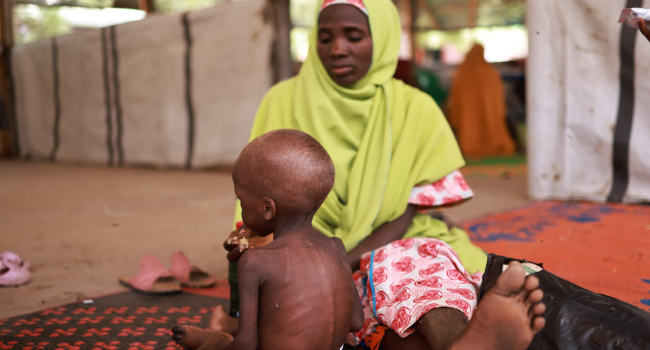
Nigeria’s Vice President, Kashim Shettima, has sounded the alarm over the widespread malnutrition crisis in the country, revealing that nearly 40% of children under the age of five are being deprived of their full physical and cognitive potential due to poor nutrition. This situation, he said, constitutes a national crisis that requires immediate and collective action.
Shettima, who was represented at the National Summit on Nutrition and Food Security in Abuja by Senator Ibrahim Hadejia, the Deputy Chief of Staff to the President (Office of the Vice President), described malnutrition as a severe challenge that affects not only the health of children but also the country’s economic future.
“It is a reminder of the burden that we bear — a malnutrition crisis that continues to rob nearly 40% of Nigerian children under five of their physical and cognitive potential,” Shettima noted. “It is a reminder that food insecurity is not only about hunger. It is also about whether our people can afford, access, and accept the food that meets their nutritional needs. It is about the economy. It is about education. It is about the very building blocks of human capital that this nation so urgently needs,” he stressed.
The Vice President also highlighted the federal government’s efforts to combat malnutrition, including the launch of the Nutrition 774 Initiative, a programme aimed at addressing malnutrition in some of the country’s most neglected communities. Shettima revealed that the initiative had been approved by the National Council on Nutrition, which he chairs.
According to Shettima, President Bola Tinubu’s administration has made nutrition a cornerstone of Nigeria’s national development agenda under the Renewed Hope strategy. At the heart of this strategy lies the Nutrition 774 Initiative, designed to make a tangible impact on the ground in Nigeria’s most forgotten areas.
“At the heart of this strategy lies the Nutrition 774 Initiative, our flagship grassroots framework designed not for elegance on paper, but for impact in the most forgotten corners of our nation,” Shettima said.
To ensure effective implementation, the Vice President mentioned the establishment of the Nutrition 774 Strategic Board, a high-level governance body responsible for overseeing the initiative. This board includes legislators, civil society actors, and government technocrats, demonstrating the government’s commitment to institutionalising accountability and moving beyond rhetoric.
Shettima also expressed gratitude to Nigeria’s international development partners, including the World Bank, UNICEF, Médecins Sans Frontières, and Nutrition International, for their support in strengthening community-based nutrition interventions. However, he stressed the need for better coordination among all stakeholders to avoid fragmented efforts that dilute the country’s collective strength.
“The era of fragmented interventions is over. We can no longer afford parallel systems that dilute our collective strength. Nigeria needs one plan, one voice, one framework, and unified accountability. Anything less is a betrayal of the children who depend on us,” he remarked.
Additionally, Shettima applauded the National Assembly and State Houses of Assembly for establishing a National Legislative Network on Nutrition and Food Security and replicating this initiative across all 36 states. He termed this as “an unprecedented stride in legislative engagement,” emphasizing that budgetary allocations for nutrition must be consistent, adequate, and safeguarded. He further called for oversight functions that not only audit but also measure the impact of policies.
“Budgetary allocations for nutrition must be consistent, adequate, and safeguarded. Oversight functions must transcend audits. They must measure impact. Policies must not die in chambers. They must live in communities,” Shettima concluded.
