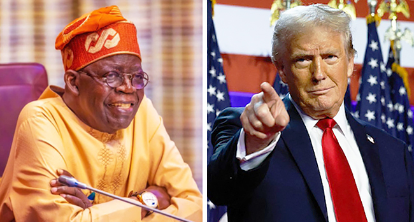
Nigeria will not bow to pressure from the United States under President Donald Trump to accept Venezuelan deportees, including former prisoners, Foreign Affairs Minister Yusuf Tuggar declared on Thursday. Speaking during an appearance on Channels Television’s Politics Today, Tuggar stressed that Nigeria faces enough internal challenges and will not become a “dumping ground” for individuals deported from the US. His remarks come amid renewed US crackdowns on undocumented migrants and mounting diplomatic tensions following Nigeria’s participation in the 2025 BRICS Summit.
President Bola Tinubu had joined fellow world leaders at the BRICS Summit held in Rio de Janeiro, Brazil, from July 6 to 7. On the summit’s final day, President Trump announced a 10 percent trade tariff on “anti-American” BRICS countries, listing China, India, and Nigeria among them. However, Tuggar suggested that the tariff hike may not be directly linked to Nigeria’s involvement in the BRICS meeting. “The issue of tariffs may not necessarily have to do with us participating in the BRICS meeting,” he said.
Tuggar revealed that the US is pushing several African countries, including Nigeria, to accept deported Venezuelans — some of whom were incarcerated in the US — but firmly ruled out Nigeria’s cooperation on the matter. “It would be difficult for countries like Nigeria to accept Venezuelan prisoners into Nigeria,” he said. “We have enough problems of our own; we cannot accept Venezuelan deportees. We already have 230 million people.”
The minister also addressed other diplomatic concerns, noting that the Tinubu administration has opened discussions with Washington regarding new visa restrictions placed on Nigerian nationals. At the same time, he described as “regrettable” the recent visa ban imposed by the United Arab Emirates. Nigeria officially became a BRICS+ partner in January 2025, joining an expanded economic bloc now comprising 11 nations and accounting for nearly 40 percent of global economic output.
