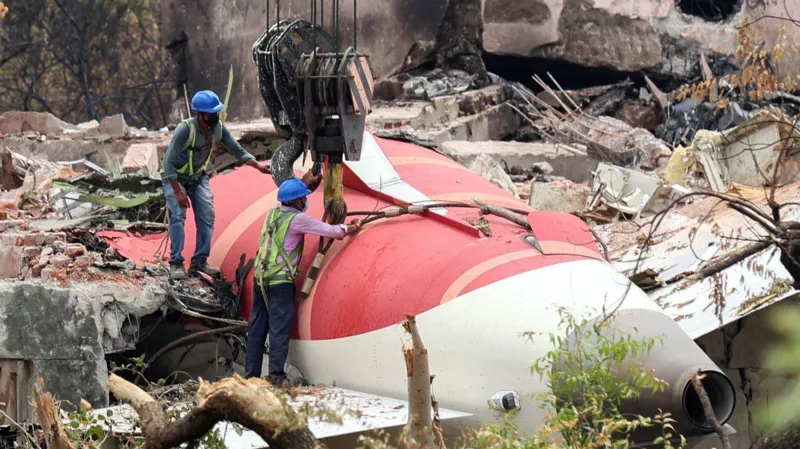
Investigators probing the devastating Air India Flight 171 crash—which claimed 260 lives in June—have unearthed chilling new evidence: cockpit voice recordings that raise even more questions than answers.
Just seconds after take-off, both of the Boeing 787 Dreamliner’s fuel-control switches moved to the “cut-off” position, starving both engines of fuel and triggering a complete power loss. Crucially, this move is typically made only after landing.
The voice recording captures one pilot asking the other why he “did the cut-off”, to which the person replies that he didn’t. The recording doesn’t clarify who said what.
At the time of take-off, the co-pilot was flying while the captain monitored. Although the switches were quickly returned to the “run” position, sparking automatic engine relight, the aircraft had already entered a critical descent. One engine was regaining thrust while the other had restarted but not recovered power before impact.
Fatal Crash After 40 Seconds in the Air
Flight 171 was airborne for less than a minute before it crashed into a densely populated neighborhood near Ahmedabad International Airport, marking one of the most baffling aviation disasters in India’s history.
According to Flightradar24 data, the aircraft climbed to 625 feet before vanishing from radar. A 15-page preliminary report released Saturday offers early insights—but few definitive answers.
Fuel Switches at the Center of Investigation
Fuel-control switches in Boeing 787-8 aircraft—like the one involved in this crash—are specifically designed with locking mechanisms and protective brackets to prevent accidental activation.
“It would be almost impossible to pull both switches with a single movement of one hand,” a Canada-based air crash investigator told the BBC. “This makes accidental deployment unlikely.”
Experts from Boeing, General Electric, Indian and international aviation regulators, and Air India are collaborating on the investigation.
Experts Question the Human Factor
“Was it intentional, or the result of confusion?” asked Shawn Pruchnicki, a former airline accident investigator. “There was no indication of such a situation here, nor any discussion suggesting that the fuel switches were selected by mistake.”
Peter Goelz, former managing director of the US National Transportation Safety Board (NTSB), called the finding “very disturbing,” noting:
“The question is, who, and why? Both switches were turned off and then restarted within seconds. The cockpit voice recorder will reveal more.”
Call for Cockpit Video Recorders
Investigators stress the importance of not just voice recordings, but visual documentation.
“They haven’t identified the voices yet,” said Goelz. “A cockpit video would show whose hand was on the switch.”
The report underscores the longstanding NTSB recommendation for cockpit video recorders, particularly for modern aircraft like the Dreamliner, where such issues can have catastrophic consequences.
Maintenance History, Crew Fitness Not in Question
The report confirmed both pilots had passed pre-flight alcohol tests and were adequately rested. The aircraft itself had no known fuel issues, and fuel samples taken from refueling tanks were deemed satisfactory.
Boeing’s 2018 Advisory Under Scrutiny
One notable point in the report: In 2018, the US Federal Aviation Administration (FAA) issued a bulletin concerning similar fuel control switches on Boeing 737s, highlighting that some may have been installed with the locking feature disengaged.
Though not considered an airworthiness risk at the time, the same switch design was used in the Boeing 787-8, including the aircraft that crashed. Air India did not inspect for the issue, as the advisory wasn’t mandatory.
“If the locking feature is disengaged, could the switch just flip itself off and shut down the engine?” Pruchnicki asked. “If so, that’s a serious issue.”
Systemic Failure Confirmed by Emergency Deployment
Investigators also confirmed deployment of the Ram Air Turbine (RAT)—an emergency generator indicating dual engine failure. The landing gear was also not retracted.
A Dreamliner pilot noted that gear retraction typically completes by 400ft altitude—far higher than the aircraft reached after engine failure.
“When both engines fail, you go numb,” the pilot explained. “In that moment, landing gear isn’t your focus. You’re just trying to keep the aircraft in the air.”
Engines Restarted Too Late to Prevent Crash
Investigators believe the pilots did attempt to restart the engines, with the left engine recovering first. But the right engine never regained enough thrust.
“Both were eventually set to ‘run’, but with the left shut down first and the right too late to recover, it was simply too little, too late,” said Pruchnicki.
