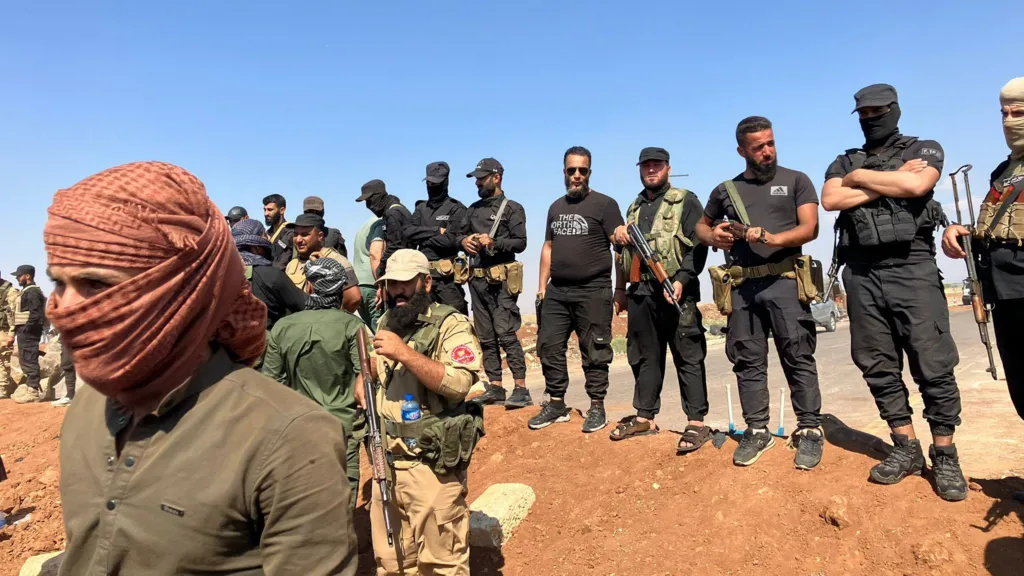
In the wake of deadly sectarian clashes in Syria’s southern Suweida province, Bedouin fighters have warned that they may resume hostilities with the Druze community unless their demands are met. The Bedouin fighters, who recently retreated from the city, have called for the release of their wounded and detained fighters, accusing the Syrian government of breaching a ceasefire agreement. Despite a brief period of calm, tensions remain high.
For nearly a week, Suweida, home to a large Druze population, witnessed fierce fighting between Druze, Bedouins, and Syrian government forces. The violence escalated following the abduction of a Druze merchant on the road to Damascus. The clashes saw both Druze and Bedouin fighters accused of committing atrocities, as well as government forces and foreign fighters becoming embroiled in the bloodshed. Israel, which has historically supported the Druze, intervened with airstrikes targeting Syrian forces and militias.
On Sunday, the UK-based Syrian Observatory for Human Rights (SOHR) reported a “cautious calm” in the region, though tribal fighters had continued to attack surrounding villages. Smoke was visible rising from Suweida as tribal fighters stood at checkpoints outside the city, demanding the release of their wounded fighters. A tribal elder, speaking to the BBC, warned that unless the Syrian government honors its agreement, they would return to Suweida, even at the risk of further violence. “If they don’t commit to the agreement, we are going to enter again, even if Suweida will become our cemetery,” the elder stated.
The ongoing violence, which has resulted in more than 1,120 deaths, has drawn international condemnation. The SOHR reported that over 400 Druze fighters and civilians, as well as 354 government security personnel and 21 Bedouins, were killed during the clashes. The United Nations has reported that at least 128,000 people have been displaced by the violence, and humanitarian aid is severely limited.
Displaced Families and Tensions on the Ground
In the aftermath of the violence, displaced Bedouin families have sought refuge in nearby villages, including Mia’rbah. At one aid distribution centre, elderly Bedouin women collected water, and many displaced individuals—primarily women and children—awaited assistance. The scars of the civil war were evident in the ruins of Mia’rbah, where bullet-riddled buildings marked the devastation of years of conflict.
When asked about the potential for peaceful coexistence between the Bedouin and Druze communities, a displaced Bedouin woman expressed doubt, stressing that it would depend on the Syrian government’s actions. “They can live together if the government will take over and rule, and if the government will provide peace and security,” she said. However, she voiced distrust in the Druze, claiming, “They are traitors, without peace and security we can’t live with them.”
As humanitarian convoys slowly begin to reach the affected areas, the international community is closely monitoring the situation. US Secretary of State Marco Rubio has called for accountability, demanding that those responsible for atrocities, including members of the Syrian government, be brought to justice.
The Road Ahead
With both Bedouin and Druze fighters remaining entrenched in their positions, and with the government under immense pressure to restore peace, the situation in southern Syria remains volatile. The continuing violence underscores the fragility of the ceasefire and the difficulty of rebuilding trust between the two communities, especially in the absence of a functioning government authority in the region.
The conflict in Suweida is emblematic of the broader challenges facing Syria as it grapples with a fractured political and military landscape. International efforts to mediate the situation and provide humanitarian aid continue, but the road to peace remains uncertain.
