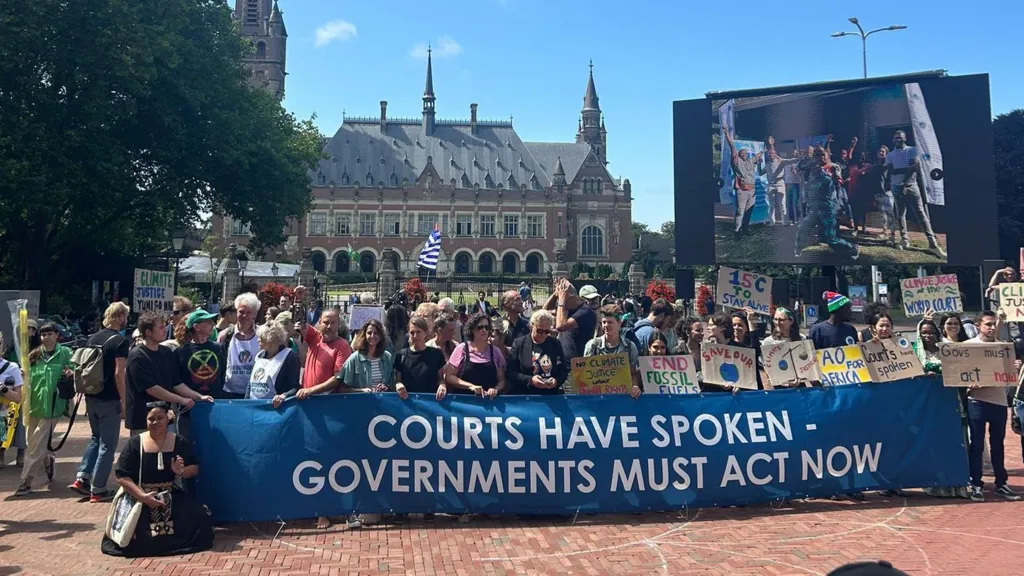
A historic ruling by the International Court of Justice (ICJ) has opened the door for countries to sue each other over climate change impacts, including those related to historic emissions of greenhouse gases. The court’s advisory opinion, released on Wednesday, has profound implications for the global fight against climate change and the legal frameworks surrounding environmental responsibility.
The landmark decision was hailed by vulnerable nations, particularly low-lying Pacific islands, that have long suffered from the devastating effects of climate change. These nations, frustrated by the lack of global progress in addressing the climate crisis, have turned to the court as a means of seeking justice.
In a statement outside the Peace Palace in The Hague, Flora Vano from Vanuatu, widely considered the most climate-vulnerable country globally, expressed immense relief. “This is a victory not just for us but for every frontline community fighting to be heard,” Vano stated. “Tonight I’ll sleep easier. The ICJ has recognised what we have lived through – our suffering, our resilience and our right to our future.”
The case was the brainchild of a group of young law students from the Pacific islands, who conceived the idea in 2019. One of those students, Siosiua Veikune from Tonga, was in attendance to witness the ruling. “I’m lost for words. This is so exciting. There’s a ton of emotions rushing through us,” Veikune said.
Legal and Environmental Implications
The ICJ’s advisory opinion, while non-binding, sets a critical precedent for future litigation regarding climate change and compensation. Lawyers and environmental campaigners see the ruling as a significant step toward holding historically high-emitting nations accountable for the damage caused by their industrial activities.
Judge Iwasawa Yuji, who presided over the ruling, clarified that countries failing to implement ambitious climate plans could be in violation of their promises under the Paris Agreement. The court also emphasised that nations, whether signatories to the agreement or not, have a legal obligation to protect the environment and the climate system.
Joie Chowdhury, Senior Attorney at the Centre for International Environmental Law, hailed the ruling as a “watershed legal moment.” She noted that the decision affirms the right of those affected by climate devastation to seek compensation for climate harm, a crucial step in ensuring that accountability for climate change is a global priority.
Compensation for Climate Damages
The ruling could open the door for climate-vulnerable nations to seek compensation for the extensive damage caused by climate change, including destruction of infrastructure and extreme weather events. The court confirmed that where it is impossible to restore a country’s lost infrastructure, governments may be entitled to compensation.
Although the ruling did not specify the financial implications of such claims, experts suggest that the global cost of climate change-related damage between 2000 and 2019 is estimated at $2.8 trillion, or $16 million per hour. The Marshall Islands, for example, has calculated its adaptation costs at $9 billion—an amount the island nation cannot afford.
Global Reactions and Legal Ramifications
The UK government has responded cautiously, stating that it is reviewing the opinion before issuing a detailed response. “Tackling climate change is and will remain an urgent UK and global priority,” a spokesperson for the UK Foreign Office said.
However, some legal experts remain sceptical about whether the ruling will result in tangible outcomes. “The ICJ is an institution that is subject to geopolitics,” said Harj Narulla, a climate barrister. “It relies on states adhering to its judgements, and it doesn’t have a police force.”
Developing countries, however, are now empowered by the ICJ’s opinion to seek damages in national and international courts. Although the US and China have not agreed to the ICJ’s jurisdiction, the ruling may still be cited in cases brought before their courts.
The Path Forward
As legal experts analyse the impact of this ruling, one thing is clear: the decision represents a turning point in the global climate change debate. It provides new avenues for climate-vulnerable nations to pursue compensation, and challenges high-emitting countries to take responsibility for the environmental consequences of their historical actions.
The ruling is likely to fuel further litigation and may prompt new international climate agreements aimed at more effective environmental protections. For countries like Vanuatu, which has spearheaded the case, the ruling is seen as a critical victory in the fight for climate justice.
