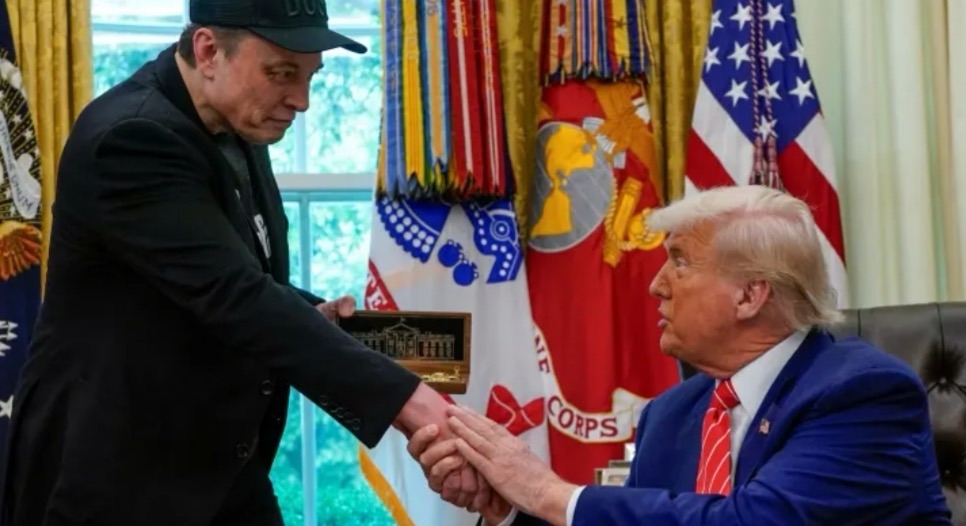
In a striking reversal of earlier remarks, former President Donald Trump said this week that he has no intention of “destroying” Elon Musk’s companies by revoking federal subsidies, signaling a cooling of tensions between two of the country’s most high-profile figures.
“Everyone is stating that I will destroy Elon’s companies by taking away some, if not all, of the large scale subsidies,” Trump posted on Truth Social on July 24. “This is not so. I want Elon, and all businesses within our Country, to THRIVE.”
The statement contrasts sharply with Trump’s prior rhetoric. Just last month, he hinted that his administration would consider slashing government subsidies and contracts to major tech firms including Musk’s as part of a broader effort to curb federal spending. The suggestion came amid escalating tensions between the two billionaires, fueled by Musk’s criticisms of Trump’s legislative agenda and his alleged ties to controversial figures.
Musk, CEO of Tesla, SpaceX, and X (formerly Twitter), responded to Trump’s latest post with a terse, one-word message: “Phew.” However, he did not let the opportunity pass to challenge Trump’s framing of the issue. “The so-called subsidies he’s referring to simply do not exist,” Musk posted, arguing that federal support for clean energy has largely been phased out while subsidies for fossil fuels remain intact.
Musk further warned that scaling back contracts, particularly those with NASA and the Pentagon, could not only hinder U.S. space operations but ultimately cost taxpayers more. “SpaceX contracts save billions,” he wrote. “Cutting them would be deeply counterproductive.”
Billions at Stake
Musk’s companies have received significant federal and state funding over the years. Since 2007, they have been awarded an estimated $38 billion in combined subsidies and government contracts. This includes roughly $15 billion from NASA, $6 billion for Starlink satellite expansion, and over $11 billion in incentives for Tesla’s electric vehicle and battery production facilities.
A recent review by Trump’s transition team reportedly explored ways to reduce this funding. However, insiders said most contracts were deemed too vital to national security and economic interests to terminate.
A Political Tightrope
The dustup reflects the increasingly complex relationship between tech industry leaders and political powerbrokers. Trump’s tone shift appears aimed at calming markets and business leaders wary of government overreach. Meanwhile, Musk’s response underscores the tension between private innovation and public policy, especially as federal support for clean energy continues to decline under current leadership.
Though the immediate threat to Musk’s funding may be receding, the broader debate over government support for tech and space innovation is far from settled.
