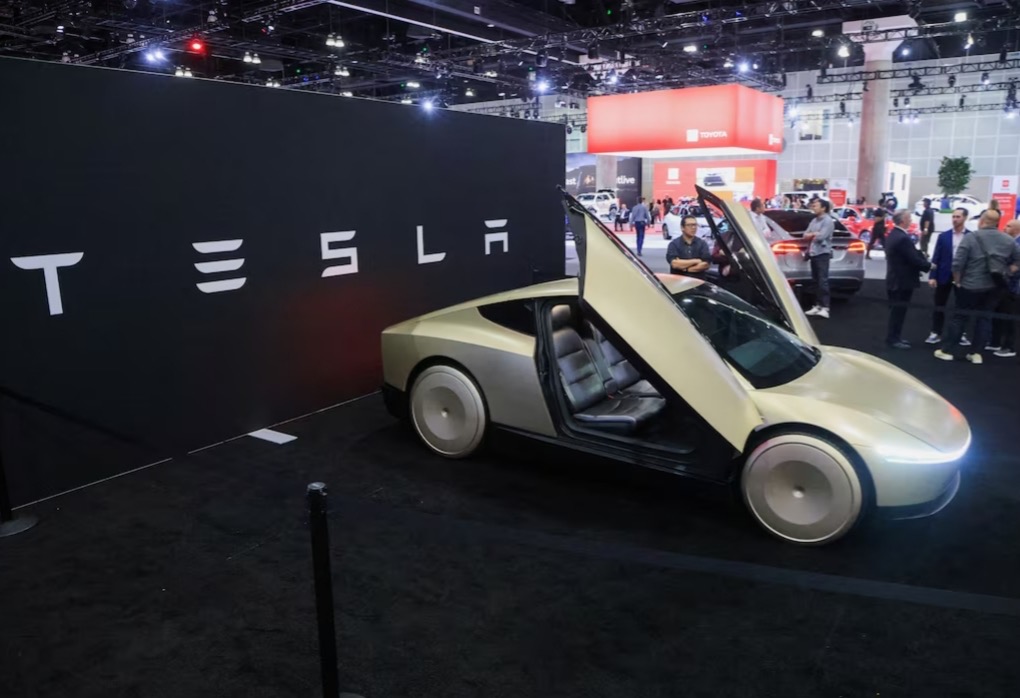
Tesla CEO Elon Musk has confirmed a landmark semiconductor agreement with Samsung Electronics, valued at $16.5 billion, marking one of the most significant tech partnerships in recent years. The multi-year deal will see Samsung supply Tesla with advanced chips through 2033, with a focus on powering Tesla’s next-generation artificial intelligence (AI) and autonomous driving platforms.
The announcement follows Samsung’s earlier disclosure of the deal last week without naming the client due to confidentiality clauses. However, three independent sources confirmed Tesla as the counterparty before Musk publicly validated the news on Monday via X (formerly Twitter).
Advanced AI Chips to Be Built in Texas
Central to the agreement is Samsung’s new semiconductor fabrication facility in Taylor, Texas, which Musk confirmed will be dedicated to producing Tesla’s in-house AI6 chips. These chips are integral to Tesla’s full self-driving (FSD) systems and AI training infrastructure.
“Samsung agreed to allow Tesla to assist in maximizing manufacturing efficiency,” Musk wrote. “I will walk the line personally to ensure optimal performance. The Taylor fab is just down the road from my home.”
Musk’s direct involvement signals the strategic importance of this deal for Tesla, especially as it pushes toward achieving full autonomy and scaling its AI capabilities.
Boost for Samsung’s Foundry Business
The deal provides a critical lift for Samsung’s struggling foundry division, which has reported operating losses exceeding ₩5 trillion (~$3.6 billion) in the first half of 2025. Following the announcement, Samsung’s shares surged more than 4% on the Seoul stock exchange.
While industry insiders say the AI6 chips will likely not use Samsung’s most advanced 2-nanometer process still facing yield issues the collaboration is expected to bring manufacturing innovations and improved process control under Tesla’s guidance.
Strategic U.S.–South Korea Technology Alliance
Beyond commercial interests, the partnership reinforces growing technological cooperation between the United States and South Korea amid global supply chain shifts and semiconductor trade tensions. The Texas facility, funded in part by U.S. federal incentives, is a keystone in America’s efforts to onshore chip production.
“This is a win-win for both nations,” said Dr. Lena Park, senior fellow at the Korea Advanced Institute of Science and Technology. “It gives Samsung a steady high-tech customer, while Tesla gains more control over its critical chip supply amid geopolitical uncertainties.”
Looking Ahead
The Tesla-Samsung chip deal extends well into the next decade, and industry observers believe it may signal a broader trend of automakers taking a more hands-on approach in semiconductor design and manufacturing.
With Tesla’s AI ambitions accelerating and Samsung looking to reclaim global foundry leadership, this agreement could redefine the future of AI hardware production.