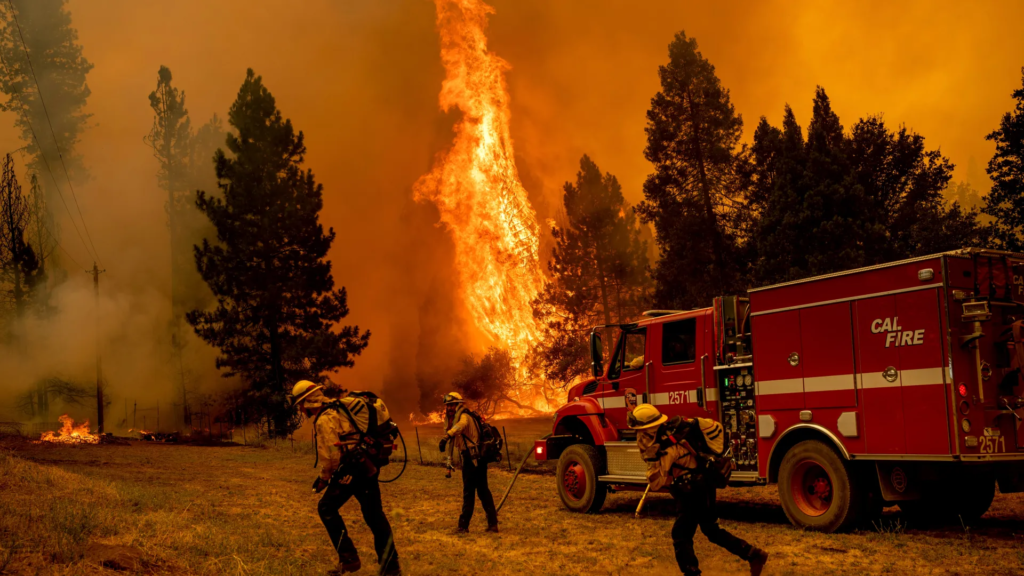
The European Union is grappling with its most devastating wildfire season since records began in 2006, with more than one million hectares of land scorched so far this year. Scientists warn the crisis underscores the mounting toll of climate change across the continent.
Spain and Portugal have borne the brunt of the destruction, with nearly 1 percent of the Iberian Peninsula consumed by flames. According to the Copernicus European Forest Fire Information System, Spain has already lost more than 400,000 hectares of land—six times the national average for this period. In Portugal, about 270,000 hectares have burned, nearly five times the usual level. Combined, the Iberian burn area has reached 684,000 hectares, four times the size of Greater London.
The wildfires have been concentrated in forested areas of northern Portugal and Spain’s regions of Galicia, Asturias, and Castile and León. Iconic landscapes such as Picos de Europa National Park and pilgrimage routes along the Camino de Santiago have been scarred, while smoke from the fires has traveled as far as France and the United Kingdom. The EU has deployed its largest-ever civil protection firefighting force in response.
Experts link the surge in Mediterranean wildfires directly to global warming. A rapid attribution study by the World Weather Attribution group at Imperial College London found that human-driven climate change made extreme fire conditions in southern Europe up to 10 times more likely this summer. Rising heat dries out vegetation, increasing flammability and creating the conditions for uncontrollable blazes.
“Today, with 1.3 degrees Celsius of warming since pre-industrial times, we are seeing new extremes in wildfire behavior that have pushed firefighters to their limit,” said Theodore Keeping, a wildfire scientist at Imperial College London.
The carbon emissions from this year’s Spanish wildfires have reached unprecedented levels. According to EU data, the fires released 17.68 million tonnes of CO2—more than Croatia’s total annual emissions in 2023. Researchers warn that this feedback loop, in which hotter fires release more greenhouse gases, is accelerating climate change itself.
The impact extends beyond air quality and climate. Rural depopulation is also compounding fire risks in southern and eastern Europe. As younger generations leave the countryside for urban areas, farmland that once served as natural firebreaks is abandoned, leaving behind dense, highly flammable vegetation.
While Mediterranean ecosystems are historically adapted to periodic fires—native species like the Iberian hare and cork oak often thrive after burns—the scale and frequency of modern wildfires are overwhelming natural recovery. Scientists caution that repeated fires risk permanent ecosystem damage, soil erosion, and water contamination from ash runoff.
“A warming climate is driving more frequent and larger fires, which is in turn driving carbon emissions that remain in the atmosphere, which is leading to a warmer climate,” said Thomas Smith, associate professor of environmental geography at the London School of Economics.
Officials and researchers stress that managing excess vegetation, improving fire detection systems, and curbing fossil fuel use are critical to limiting the damage. “It was urgent 10 years ago to stop burning fossil fuels,” said Dr. Fredi Otto, professor of climate science at Imperial. “Today it has become lethal for people and ecosystems.”
With more extreme heat waves projected in the years ahead, scientists warn that Europe’s record wildfire season may soon become the norm.