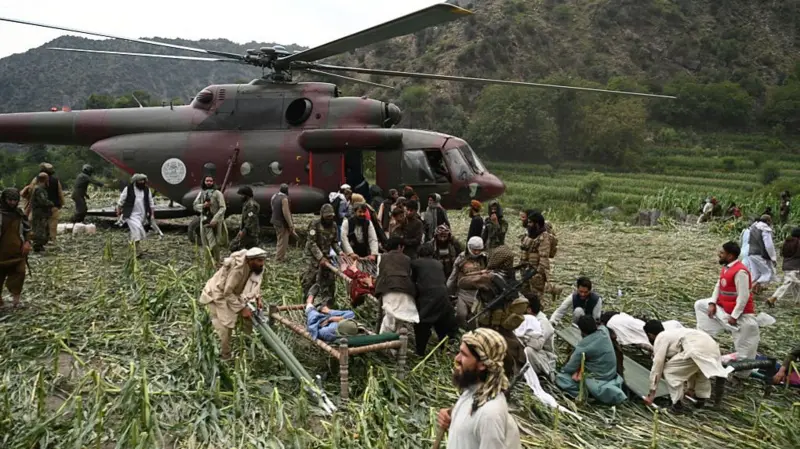
Helicopter crews fanned out across Afghanistan’s remote eastern provinces Monday as rescuers raced to find survivors of a powerful earthquake that killed more than 800 people and injured at least 1,800, according to the United Nations.
The magnitude 6.0 quake struck Sunday in mountainous Kunar province at a shallow depth of just 8 kilometers (5 miles), making it especially destructive. Tremors were felt in Kabul and as far away as Islamabad, Pakistan. Entire villages were flattened, and landslides cut off already difficult mountain roads, forcing much of the rescue to be carried out by air.
Local officials warned the death toll could climb sharply as more bodies are pulled from the rubble. “We cannot accurately predict how many bodies might still be trapped,” said Ehsanullah Ehsan, head of Kunar’s disaster management agency. “Our effort is to complete these operations as soon as possible and to begin distributing aid to the affected families.”
At Jalalabad’s main hospital, patients filled wards and hallways. Doctors, already stretched by years of underfunding, pleaded for supplies. “The Red Cross is offering assistance, but we need more help,” one physician told the BBC. “Thousands have lost their homes. We need tents. We need medicine.”
The stories of survivors underscored the scale of devastation. Mir Zaman, a father from Kunar, said he dug through the ruins of his house to recover the bodies of his twin daughter and younger son. “It was dark. There was no light. Someone lent me a lamp, and then I used a shovel and pickaxe to dig them out,” he said. “There was no one to help because everyone was affected.”
Children were among the most severely injured. Two-and-a-half-year-old Maiwand, his head bandaged after heavy blood loss, was turned away from multiple clinics before finally being admitted in Jalalabad. “You can see his situation. It’s so tragic,” his uncle said.
The Taliban-led government has appealed for international aid. The UN released $5 million from its global emergency fund, while Britain pledged £1 million ($1.3 million) in relief, emphasizing that the money would be channeled through humanitarian partners rather than Taliban authorities. India delivered 1,000 tents and 15 tons of food to Kabul, with more shipments on the way, and China also promised assistance.
Amy Martin, head of the UN’s humanitarian agency in Afghanistan, said shelter, blankets and food remain the most urgent needs. “We are preparing hot meals and high-energy biscuits and are working to reach as many people as possible,” she said. But she noted that deep cuts to international assistance have crippled Afghanistan’s ability to respond. More than 80 clinics in quake-hit areas have shut down due to funding shortages, she said.
The disaster comes as Afghanistan struggles with overlapping crises of drought, hunger and isolation following the Taliban’s 2021 return to power. Aid agencies warn that women and girls, particularly in conservative Kunar province, may face delays in treatment due to cultural restrictions. “Women and girls are bearing the brunt of the crisis, as it happens always,” said Deepmala Mahla of CARE.
Afghanistan is highly vulnerable to earthquakes, sitting atop several fault lines between the Indian and Eurasian tectonic plates. In 2023, more than 1,400 people were killed in Herat province by a series of quakes. In 2022, another earthquake in eastern Afghanistan killed 1,000 people.
As helicopters continued to shuttle survivors from isolated valleys Monday, doctors, aid workers and families braced for more grim discoveries. “The full scale of the disaster will take days to assess,” said correspondent Yogita Limaye, reporting from Jalalabad.
