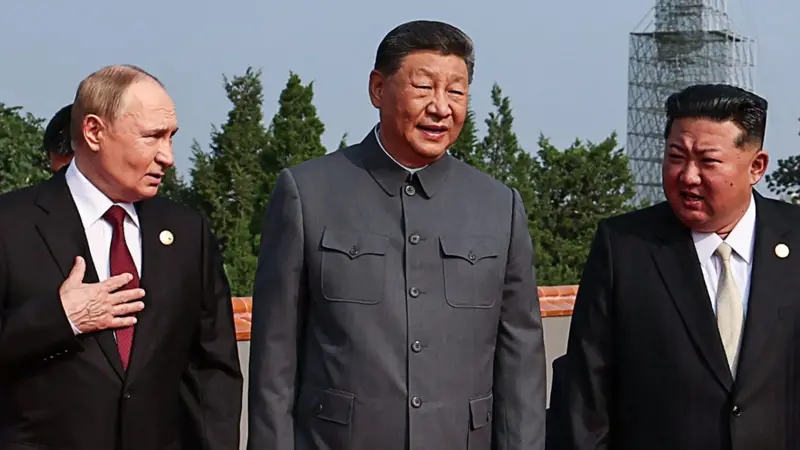
China on Wednesday staged one of its largest-ever military parades in Beijing, unveiling an arsenal of new weapons as President Xi Jinping positioned his country as a rising global power alongside Russia’s Vladimir Putin and North Korea’s Kim Jong Un.
The event, held in Tiananmen Square to mark the 80th anniversary of China’s victory over Japan in World War II, drew 26 heads of state and a tightly vetted crowd of 50,000. It was the first time Xi, Putin and Kim had appeared together in public, a striking display of solidarity among three of Washington’s most outspoken adversaries.
Xi showcased new hypersonic missiles, laser weapons, nuclear-capable intercontinental ballistic missiles, robotic “wolves” designed for frontline combat, and giant underwater drones. Western analysts noted that the array of weaponry underscored Beijing’s determination to challenge U.S. naval power and accelerate China’s drive for a credible second-strike nuclear capability.
Putin and Kim, both isolated internationally by sanctions and wars of their own, were given prominent positions at the parade. Meeting on the sidelines, Kim told Putin it was North Korea’s “fraternal duty” to help Russia. Moscow has acknowledged that North Korean soldiers fought in the Ukrainian region of Kursk, with Putin praising them for aiding in what he described as the fight against “neo-Nazism.” Kim added that bilateral cooperation had strengthened since the two countries signed a 2024 mutual defense treaty.
The symbolism of the three leaders walking side by side before rows of goose-stepping troops was not lost on observers. “President Xi welcoming North Korea’s Kim Jong Un with a long handshake, then greeting Vladimir Putin before all three walked together to watch the parade was sheer political theatre,” one correspondent reported from Beijing.
Xi used the occasion to deliver a sharp message to the United States without naming it directly. At a luncheon with foreign leaders, he declared that the world must “never return to the law of the jungle, where the strong prey on the weak.” In another speech, he added: “Strength may prevail for a time, but over the long arc of history, it is reason that wins. Justice, light, and progress will always triumph over evil, darkness, and reaction.”
Former U.S. president Donald Trump, who was not invited, responded from afar, writing on social media: “Please give my warmest regards to Vladimir Putin and Kim Jong Un as you conspire against the United States of America.”
India’s Prime Minister Narendra Modi, who had shared the stage with Xi and Putin at a regional summit just two days earlier, was notably absent. Analysts pointed to deep-seated mistrust between Beijing and New Delhi despite recent talks, ongoing trade disputes, and lingering anger in India over deadly border clashes in 2020.
Military experts described the display as both a show of confidence and a signal of insecurity. China’s ability to mass-produce diverse weapons, from drones to anti-ship missiles, demonstrates rapid progress. Yet analysts warned that Beijing’s lack of recent battlefield experience and the internal purges within its Rocket Force raise doubts about how effectively the People’s Liberation Army could integrate such systems in real combat.
The parade concluded with a flyover, the release of doves and balloons, and Xi raising a glass of Chinese wine in a toast to “common prosperity for all humankind.” It was, observers said, a carefully choreographed demonstration of power aimed not only at honoring history but at shaping a new world order with China at its center.
