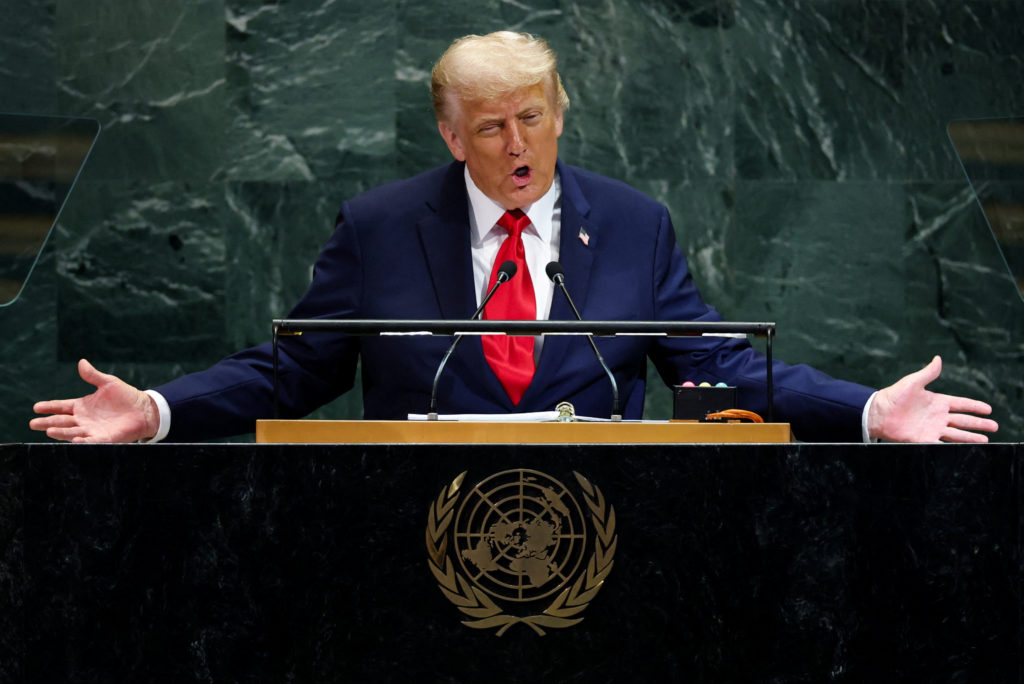
Six years ago, Donald Trump drew laughter at the United Nations. This year, the audience sat largely in silence as the former president delivered a combative address that offered Trumpism in its rawest form.
Over nearly an hour, Trump praised the United States and himself while attacking his opponents, multilateral institutions, and European allies. He claimed the U.S. was experiencing a golden age and repeated his disputed assertion that he had “ended seven wars,” suggesting the achievement merited a Nobel Peace Prize.
Trump then turned his fire on the UN itself, accusing it of failing in its mission. He mocked the organization as a body that issues “strongly-worded letters” without results, dismissing its efforts as “empty words.” He accused the UN of facilitating migration into the United States, declaring: “The UN is supposed to stop invasions, not create them and not finance them.” He even cited a broken escalator and teleprompter during his visit as evidence of dysfunction.
Many analysts share concerns about the UN’s effectiveness amid Security Council gridlock and bureaucratic inertia. But Trump’s disdain for multilateralism has also weakened the body. Under his administration, Washington cut funding, forcing the UN to scale back humanitarian work worldwide.
Trump saved his sharpest criticism for Europe, condemning leaders for embracing renewable energy and allowing large-scale migration. “Europe is in serious trouble. They have been invaded by a force of illegal aliens like nobody has ever seen before… Both the immigration and suicidal energy ideas will be the death of Western Europe,” he said.
On climate change, Trump triggered audible gasps when he dismissed it as “the greatest con job ever perpetrated on the world,” warning Europeans that renewable energy would devastate their economies compared to fossil fuels. He singled out the UK for taxing North Sea oil, warning: “If you don’t get away from the green energy scam, your country is going to fail.”
The speech carried cultural undertones as well, with Trump framing immigration as a threat to Europe’s Judeo-Christian heritage. “Let us protect religious liberty, including for the most persecuted religion on the planet today – it’s called Christianity,” he said.
On Ukraine, Trump signaled a tougher tone toward Moscow. He warned that Russia’s refusal to end the war was “not making Russia look good” and threatened “a very strong round of powerful tariffs.” He urged Europe to stop buying Russian energy and later declared on social media that Kyiv could win back all its territory, dismissing Russia as a “paper tiger.” Diplomats noted this was Trump’s sharpest rebuke of Moscow to date, though he offered no promise of U.S. military support.
The moment underscored Trump’s foreign policy worldview: a defense of nationalism and unilateral dealmaking, an assault on international institutions, and a mix of praise, scorn, and sweeping claims.
Six years ago, world leaders laughed at Trump’s rhetoric. This time, they listened in silence. “I am really good at this stuff,” he told them. “Your countries are going to hell.”