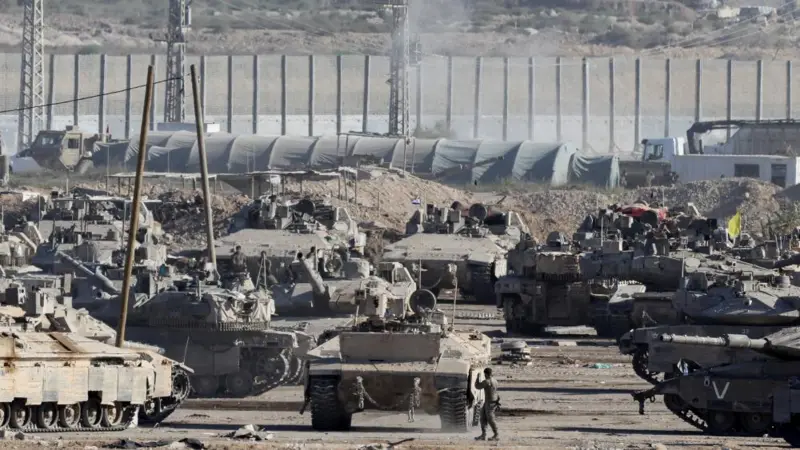
Israel has begun pulling troops back from parts of the Gaza Strip after the government approved a ceasefire agreement with Hamas, a deal that also includes the release of hostages in exchange for Palestinian detainees. Residents in Gaza told reporters that Israeli forces had withdrawn from the north-western outskirts of Gaza City, retreating eastwards toward what has been described as the “agreed line” in the first phase of the plan.
Israeli media reports confirm that the Israel Defense Forces are repositioning, moving to a point that will leave Israel with control of about 53% of the Gaza Strip. This movement aligns with a map released earlier by the White House, marking the initial line of withdrawal under President Donald Trump’s 20-point peace plan. The IDF is expected to reach these positions by noon local time, according to Israeli military radio.
Once troops reach the designated line, Hamas will have 72 hours to begin releasing hostages. In return, Israel is expected to free hundreds of Palestinian prisoners, including detainees from Gaza. “We desperately need the complete end to all of the fighting alongside the release of hostages,” UK Foreign Secretary Yvette Cooper said, confirming that international discussions on rebuilding and aid logistics are underway.
Despite the agreement, air strikes and artillery fire continued overnight and into Friday morning, particularly around Khan Younis and Gaza City. Eyewitnesses reported explosions and plumes of smoke above residential areas, causing confusion among displaced civilians unsure of when it will be safe to return to what is left of their homes.
In Gaza, the atmosphere has shifted from brief celebration to uncertainty. “Looters tried to ransack my barbershop… soldiers opened fire at us,” said Mohammed Imad al-Din, who fled Khan Younis weeks ago. Others reported hearing shelling around the Netzarim corridor, even after the ceasefire was meant to take immediate effect following Israel’s cabinet approval.
At Hostages Square in Tel Aviv, crowds gathered in anticipation of the release. “Trump is a major reason for the success — I hope it is a success, right now it is only promises,” said 71-year-old Rafi Rabinovitz, one of the many praying publicly for a peaceful outcome.
Humanitarian aid convoys are expected to move into Gaza as soon as the ceasefire is operational, with a surge of supplies planned for the more than two million displaced residents. However, the Palestinian Civil Defence authority has urged civilians to avoid areas previously occupied by Israeli troops until an official announcement confirms a full withdrawal.
The United States is reportedly moving 200 troops already stationed in the Middle East to Israel to coordinate a multinational monitoring force involving Egypt, Qatar and Turkey. Officials say no American troops will enter Gaza, but will oversee ceasefire compliance and humanitarian access through a civil-military coordination centre.
Australian Prime Minister Anthony Albanese welcomed the development, saying, “We have called for some time for a ceasefire for the release of hostages… we also need to talk about the day after.” He also congratulated President Trump for what he called a “significant diplomatic breakthrough.”
While the ceasefire marks the first tangible step in the peace plan, UN officials warn that “a lot can go wrong,” citing unresolved disputes over future governance of Gaza, the role of Hamas, and the timeline for Israel’s full withdrawal beyond the initial 53% control zone.
For now, Gaza stands at a fragile crossroads — between hope for relief and fear that the guns have not yet truly fallen silent.
