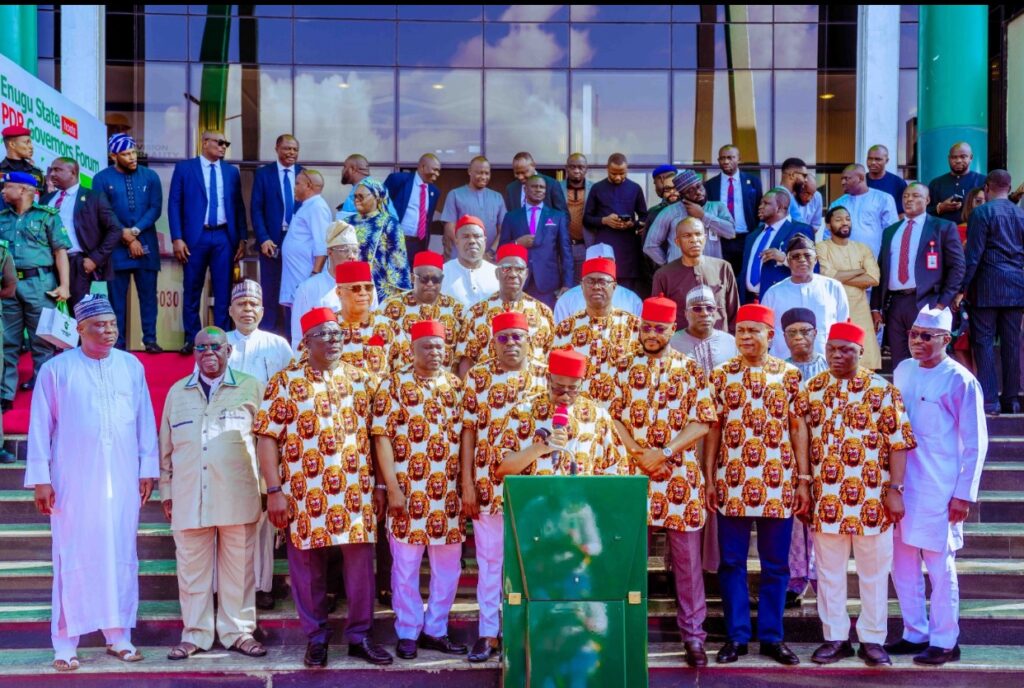
The Peoples Democratic Party (PDP) is facing one of its toughest political crises in recent years as a growing wave of defections continues to weaken the once dominant opposition party.
Bauchi State Governor and Chairman of the PDP Governors’ Forum, Senator Bala Mohammed, recently admitted that the party is powerless to stop the exodus of its key members. Speaking on October 11, the governor expressed concern over the growing defections, including that of Enugu State Governor Peter Mbah, who joined the All Progressives Congress (APC) days after news of his planned defection broke.
Before the week ended, Bayelsa State Governor Douye Diri, another key PDP figure, also dumped the party, citing political and developmental reasons for his decision. The recent departures have reduced the PDP’s control to eight states, down from thirteen in 2023.
Analysts say the opposition party’s inability to halt the defections is rooted in a deeper leadership and strategic crisis that has plagued it since losing power to the APC in 2015. The party, they note, has failed to produce a unifying and visionary leadership capable of rebuilding its base and redefining its mission.
Former President Goodluck Jonathan, whose administration’s defeat marked the beginning of PDP’s decline, has largely distanced himself from the party’s affairs. Efforts to rebuild the party have been hindered by infighting and a lack of political direction.
Former Rivers State Governor Nyesom Wike once filled that leadership vacuum by energising the party with resources and strategic focus. However, his fallout with the 2023 presidential candidate, Alhaji Atiku Abubakar, created further divisions that crippled the PDP’s internal cohesion.
Political observers believe that the PDP’s current challenges go beyond the defections. They argue that the party lacks a coherent strategy to reinvent itself, attract new members, and inspire confidence among Nigerians.
Experts suggest that to survive, the PDP must undertake a total overhaul of its structure, rediscover its founding ideals, and invest in nurturing a new generation of visionary leaders. They also advise the party to focus on rebuilding rather than rushing into another presidential contest in 2027.
While some commentators have predicted the PDP’s eventual collapse, others maintain that the party still holds the potential to bounce back if it embraces genuine reform, unites its fractured ranks, and positions itself as a credible alternative to the ruling APC.
