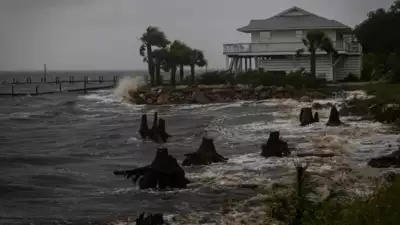
Hurricane Helene, classified as “extremely dangerous,” made landfall in Florida on Thursday, with officials warning of “unsurvivable” conditions and a storm surge that could submerge a two-story house.
Over a million people were left without power, and many roads were already flooded ahead of what is expected to be one of the largest storms in the Gulf of Mexico in decades. Helene intensified to a Category 4 hurricane, with winds reaching 140 miles per hour as it struck near Perry around 11:10 PM local time.
The National Hurricane Center (NHC) emphasized the risk of catastrophic storm surge along the Florida Big Bend coast, urging residents to heed warnings. Airports in Tampa and Tallahassee closed, and cities like St. Petersburg and Sarasota reported flooding.
NHC director Mike Brennan warned of potential inundation levels of 15 to 20 feet, saying, “That’s up to the top of a second-story building. This is a really unsurvivable scenario.” He added that the accompanying waves could destroy homes and rapidly elevate water levels.
President Joe Biden urged residents in the storm’s path to follow evacuation orders, stressing the importance of safety. In Taylor County, officials advised those ignoring mandatory evacuation orders to write their names on their bodies in permanent marker for identification purposes.
Residents in affected areas were taking precautions. David Wesolowski in Alligator Point was boarding up his house, acknowledging the storm’s potential impact. Meanwhile, Patrick Riickert in Crawfordville planned to ride out the storm with his family, despite most neighbors evacuating.
John Luper, filling jerry cans with fuel at a gas station, expressed his reluctance to leave due to family members refusing to evacuate. The NHC predicted up to 20 inches of rain in certain areas, raising concerns of life-threatening flooding and landslides.
Warnings of tornadoes spread across northern Florida, Georgia, and the Carolinas, with more than 55 million Americans under some form of weather alert related to Hurricane Helene. Federal Emergency Management Agency administrator Deanne Criswell indicated the storm could significantly impact multiple states, extending from Florida to Tennessee.
Vice President Kamala Harris stated that the White House was closely monitoring the situation and urged everyone to take the storm seriously. Florida Governor Ron DeSantis mobilized the National Guard and prepared for search-and-rescue operations, emphasizing the need for residents to take precautions.
As Helene threatens to be the most powerful hurricane to hit the U.S. in over a year, scientists warn that climate change may be contributing to the rapid intensification of such storms, fueled by warmer ocean temperatures.
