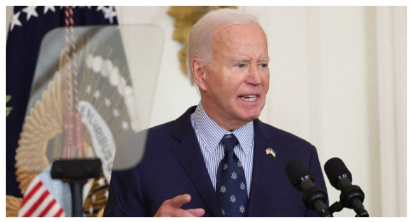
President Joe Biden announced Thursday that he will issue a formal apology for the U.S. government’s history of forcibly removing Native American children from their families and placing them in an abusive boarding school system aimed at erasing their cultural identities.
The apology, which Biden is scheduled to deliver Friday at the Gila River Indian Reservation in Arizona, addresses a traumatic period in American history. The U.S. government operated these schools from the early 19th century until the 1970s, a period spanning more than 150 years. A recent government report reveals widespread physical, mental, and sexual abuse at these institutions, resulting in the deaths of at least 973 children, many of whom were taken far from their home communities.
“I’m heading to do something that should have been done a long time ago,” Biden said Thursday as he left the White House. “To make a formal apology to the Indian nations for the way we treated their children for so many years.”
The investigation that led to this apology was spearheaded by Secretary of the Interior Deb Haaland, the first Native American to serve in a U.S. cabinet position. Haaland has been a key figure in shedding light on this painful history, which affected her own family. “For more than a century, tens of thousands of Indigenous children as young as four years old were taken from their families and communities and forced into boarding schools,” Haaland said. “This includes my own family.”
The abuses committed at these schools were kept out of mainstream history books for decades, Haaland said, but the administration is committed to ensuring this history is now known and acknowledged. “This terrible chapter was hidden from our history books, but now our administration’s work will ensure that no one will ever forget.”
The White House’s statement on the apology emphasizes its role in confronting painful parts of America’s history to foster understanding and healing. “The apology is being issued in order to remember and teach our full history, even when it is painful,” the statement read.
Biden’s formal apology follows similar acknowledgments in Canada, where thousands of Indigenous children died in government-run residential schools. Other countries have also begun to address their historical treatment of Indigenous populations, reflecting a global shift toward reconciliation.
The president’s visit to Arizona—a state with one of the highest Native American populations and a crucial battleground in U.S. elections—carries additional significance. As the country approaches a close presidential race between Vice President Kamala Harris and Republican former president Donald Trump, Biden’s message is expected to resonate deeply with Native American communities and reinforce his administration’s commitment to accountability and healing.
