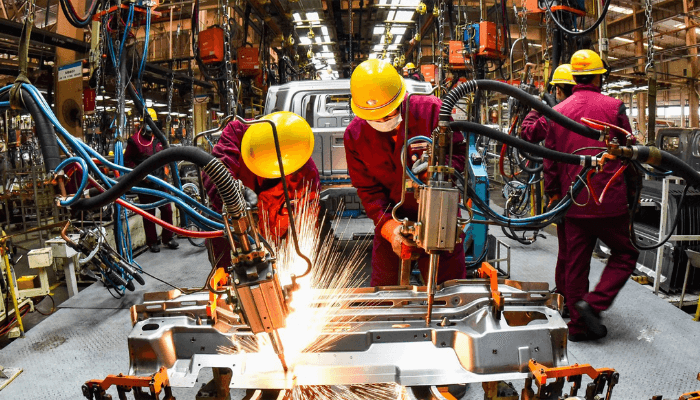
Key players in Nigeria’s manufacturing sector, including Dangote Group, BUA Group, and Flour Mills of Nigeria, increased their investments by 30% in the first half of 2024, despite ongoing economic challenges and currency depreciation. The Manufacturers Association of Nigeria (MAN) reported that total investments in the sector reached N250.13 billion in H1 2024, marking a 29.63% year-on-year rise, largely attributed to the impact of a weakened naira which inflated the cost of importing machinery and equipment.
According to MAN’s half-year review, actual investment spending remained stable, with manufacturers primarily focused on sustaining production levels rather than expanding operations due to an uncertain economic environment. “In real terms, investment spending did not increase,” MAN noted, underscoring the difficulties faced by manufacturers.
The report also highlighted a 32% investment increase in 2023, with manufacturers contributing N427.18 billion to Nigeria’s economy, up from N323.98 billion in 2022. Despite this, MAN pointed out that the real value of investments has declined due to inflation and exchange rate devaluation since the currency float in 2023. Five out of ten sub-sectors, led by food, beverages, and tobacco, saw investment increases in H1 2024, with this sector recording N93.16 billion—a 57% rise.
Companies Driving Growth
The manufacturing sector’s investment in 2023 was bolstered by industry giants such as Dangote Cement, BUA Cement, and Nestle, who initiated significant projects. For instance, BUA Cement secured a $500 million loan from the International Finance Corporation (IFC) to expand its plants, while Dangote Industries Limited began constructing a six-million-ton-per-year cement plant in Ogun State.
Emzor Pharmaceuticals, Nestle, and FrieslandCampina WAMCO also made substantial investments in local production, with Nestle allocating N61 billion to expand its facilities in Agbara, Sagamu, and Abaji. Emzor additionally received €13.85 million from the European Investment Bank to establish a $23 million facility to combat malaria.
Persistent Challenges
Despite these investments, Nigeria’s manufacturers face persistent hurdles, including soaring energy costs, a forex crunch, and fluctuating policies. The depreciation of the naira—down by over 70% since President Bola Tinubu took office—has significantly impacted the sector, making it challenging to import raw materials and essential assets.
Olaoluwa Boboye, an economist at CardinalStone, attributed the naira’s decline to speculation in the forex market, where demand for dollars has surged. The foreign exchange scarcity was ranked as the fifth biggest challenge by over 400 manufacturing CEOs, according to MAN.
High energy prices are also weighing heavily on the sector, with diesel and petrol prices surpassing N1000 per liter, further increasing production and logistics costs. “One is naturally worried about the impact on the already lackluster performance of the manufacturing sector,” MAN Director-General Segun Ajayi-Kadir commented, noting that the fuel price hike is likely to worsen inflation and reduce the purchasing power of Nigerians.
Additionally, the high cost of borrowing has become a pressing issue, with the Central Bank of Nigeria (CBN) raising the benchmark interest rate from 18.75% to 27.25%. “The average rate we got loans by the second half of 2023 was 28.1 percent,” MAN reported, reflecting the financial pressure on manufacturers.
Despite these challenges, Nigerian manufacturers remain resilient, maintaining steady investments and cautiously optimistic about the sector’s future, hoping for a more stable
