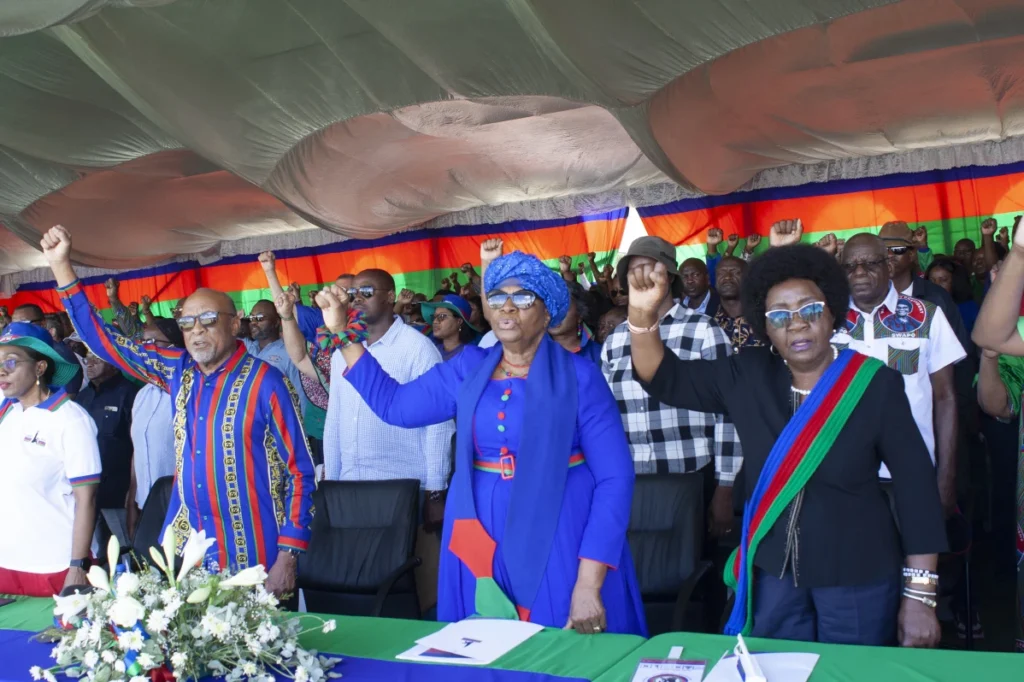
Namibia’s Vice President, Netumbo Nandi-Ndaitwah, could become the country’s first female president if she emerges victorious in the presidential election scheduled for Wednesday. With at least 1.4 million registered voters—roughly half of Namibia’s population—this election marks a pivotal moment in the country’s political history, with 15 political parties vying for both the presidency and seats in the National Assembly.
Preliminary results from special early polls for Namibia’s foreign missions, seamen, and security services, as announced by the Electoral Commission of Namibia, show that Nandi-Ndaitwah and her party, the South West Africa People’s Organization (SWAPO), are leading the race. SWAPO has been in power since Namibia’s independence from South Africa’s apartheid regime in 1990, but the party’s dominance has been challenged in recent years.
In the 2019 election, SWAPO lost its two-thirds majority in the National Assembly for the first time since 1994, a blow attributed to allegations of corruption and money laundering in Namibia’s fishing industry. High-profile arrests of cabinet ministers and businessmen further tarnished the party’s image, raising questions about its future.
Political analyst Henning Melber, a professor at the University of Pretoria and the University of the Free State, believes that SWAPO and Nandi-Ndaitwah must heed the warnings from 2019. He argues that the party’s legacy as a liberation movement has been eroded, especially among younger voters who are less emotionally tied to the party’s history. These “born-free” generations, born after Namibia’s independence, are more likely to vote based on governance and policy outcomes rather than past struggles.
At 72, Nandi-Ndaitwah has pledged to address high unemployment—particularly among young people and graduates, which currently stands at 20%. Her proposal to invest 85 billion Namibian dollars ($4.7 billion) over five years to create over 500,000 jobs has been met with skepticism by critics who question the feasibility of such ambitious goals. Additionally, issues like reproductive rights, equal pay, and healthcare for women are expected to play a significant role in shaping voter priorities.
If Nandi-Ndaitwah wins, she would join the ranks of Africa’s female presidential trailblazers, including Liberia’s Ellen Johnson Sirleaf, Malawi’s Joyce Banda, and Samba Pranza of the Central African Republic. However, political experts such as Erika Thomas, a political science lecturer at the University of Namibia, emphasize that Nandi-Ndaitwah must strive to be independent, transparent, and accountable, should she assume the presidency. “She must push for policies and legislation to improve women’s political participation and bring more women into leadership roles,” Thomas said.
The race remains tight, with strong competition from the Independent Patriots for Change, led by former dentist Panduleni Itula, and Job Amupanda’s Affirmative Repositioning party. Campaigns wrapped up with final rallies this weekend, marking the culmination of a highly charged electoral contest.
The outcome of Namibia’s election comes at a time of significant political change across Southern Africa. This year has already seen dramatic shifts, such as the African National Congress (ANC) losing its 30-year parliamentary majority in South Africa and Botswana’s Democratic Party being unseated after 58 years in power. In Mauritius, the opposition secured a landslide victory, signaling further regional upheaval.
In contrast, Mozambique’s contested election results, which saw the ruling Frelimo party declared the winner, have sparked protests that have led to at least 30 fatalities. As Namibia heads to the polls, the region watches closely to see if history will be made with Nandi-Ndaitwah’s potential rise to the presidency.
