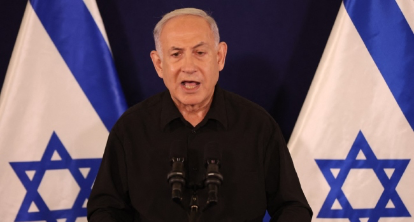
Israeli Prime Minister Benjamin Netanyahu announced plans to present a US-brokered ceasefire proposal with Hezbollah in Lebanon to his government for approval. Speaking in a televised address, Netanyahu confirmed that he would outline the ceasefire terms to ministers on Tuesday evening, emphasizing that its duration would depend on developments in Lebanon.
“The length of the ceasefire depends on what happens in Lebanon,” Netanyahu stated, warning of immediate retaliation if Hezbollah violated the agreement or attempted to rearm. “If Hezbollah violates the agreement and attempts to rearm, we will strike,” he declared.
The proposal is part of broader efforts led by the United States, with support from France, to de-escalate hostilities in Lebanon. Netanyahu assured that Israel, while seeking a ceasefire, maintains “full military freedom of action” in coordination with its key ally, the United States.
Even as Netanyahu discussed the ceasefire, the Israeli military launched strikes on central Beirut, responding to what it said were 15 projectiles fired into Israeli airspace from Lebanon. This escalation follows months of cross-border clashes, initiated by Hezbollah after Hamas’s October 7, 2023, attack on Israel that triggered the war in Gaza.
The conflict has devastated Lebanon, with at least 3,823 people killed since October 2023, according to Lebanon’s health ministry. On the Israeli side, 82 soldiers and 47 civilians have died in the hostilities, according to official reports.
Netanyahu framed the proposed ceasefire as a strategic move to allow Israel to intensify its focus on Gaza and its fight against Hamas. “With Hezbollah out of the picture, Hamas is left on its own,” he said, pledging to increase pressure on Hamas and prioritize the release of hostages taken during the October 2023 attack.
During the attack, Hamas militants captured 251 hostages, 97 of whom remain in captivity. Netanyahu reaffirmed Israel’s commitment to their rescue, describing it as part of the country’s “sacred mission.”
The ceasefire proposal reflects a broader strategy to address what Netanyahu described as a “seven-front war,” which includes threats from Gaza, the occupied West Bank, and regional actors such as Yemen, Iraq, Syria, Lebanon, and Iran.
