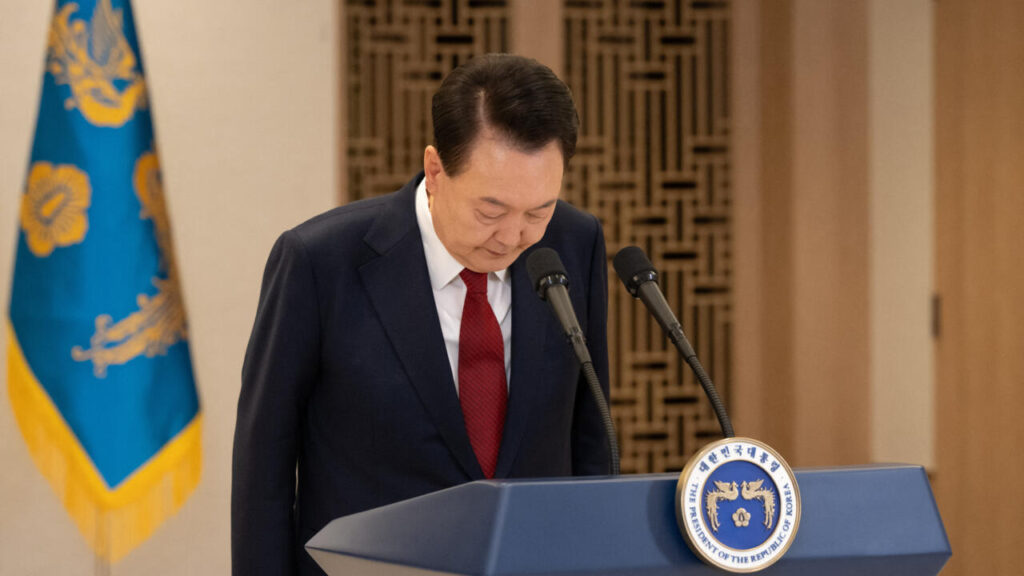
A South Korean court has issued an arrest warrant for impeached and suspended President Yoon Suk Yeol, according to investigators on Tuesday, over his brief attempt to impose martial law.
Yoon suspended civilian rule on December 3, triggering South Korea’s most significant political crisis in decades. Following the action, parliament stripped him of his presidential duties, although a constitutional court ruling is still pending to confirm the impeachment.
“The arrest and search warrants were issued this morning,” the Joint Investigation Headquarters stated.
Yoon, a conservative leader, faces criminal charges of insurrection, which could lead to life imprisonment or even the death penalty. Investigators sought the arrest warrant after Yoon failed to appear for questioning for the third time. “There is concern that the individual may refuse to comply with summons without justifiable reasons,” said an official from the Corruption Investigation Office.
The official also noted that there was “sufficient probable cause” to suspect criminal activity. The warrant is valid until January 6, with Yoon expected to be detained at Seoul’s detention center.
Yoon’s lawyer criticized the warrant, calling it “illegal and invalid,” arguing that investigators lacked the authority to probe the president. In a statement to AFP, lawyer Yoon Kab-keun said his client was not guilty of insurrection and had no intention of disrupting the “constitutional order” or staging an “uprising.”
The lawyers also announced plans to file for a court injunction to invalidate the warrant.
In addition, investigators raided the army’s Counterintelligence Command offices and indicted two senior commanders on charges linked to insurrection and abuse of authority.
By mid-afternoon Tuesday, hundreds of Yoon’s supporters had gathered outside his residence, waving South Korean flags and chanting, “Martial law legal! Impeachment invalid!” Police were dispatched in large numbers to manage the crowd, shouting at protesters to remain orderly. An official from the largest protest group supporting Yoon estimated that up to 3,000 people would join the demonstration against what they deemed an unfair arrest warrant.
Despite the issuance of the warrant, it remains unclear whether authorities will be able to execute it. The Presidential Security Service (PSS) has previously defied three search warrants. However, Yun Bok-nam, president of Lawyers for a Democratic Society, told AFP that while search warrants can be legally contested, there is no legal basis to reject an arrest warrant. He expressed confidence that the arrest process would proceed smoothly.
Local media reported that an imminent arrest or search of the presidential residence is unlikely, as investigators will likely coordinate with the PSS. Obstructing the execution of an arrest warrant could lead to arrest.
Yoon is under investigation by both prosecutors and a joint team of police, defense ministry, and anti-corruption officials. A 10-page report from the prosecutors, obtained by AFP, alleges that Yoon authorized the military to use force to enter parliament during his failed martial law attempt. The report also claims that Yoon had been in discussions with senior military officials as early as March about declaring martial law.
Yoon’s lawyer had previously dismissed the prosecutors’ report as a “one-sided account” that was inconsistent with the facts and common sense.
On December 3, Yoon made an unannounced televised address declaring martial law, citing the need to eliminate “anti-state elements.” In response, lawmakers quickly convened in parliament to vote against the declaration, while heavily armed troops stormed the building, scaling fences, smashing windows, and landing by helicopter.
South Korea’s political turmoil deepened further last week when Yoon’s successor, Han Duck-soo, was also impeached by parliament for failing to sign bills for investigations into his actions. Finance Minister Choi Sang-mok has since assumed the role of acting president and found himself at the forefront of a crisis following the Jeju Air plane crash on Sunday, which claimed 179 lives.