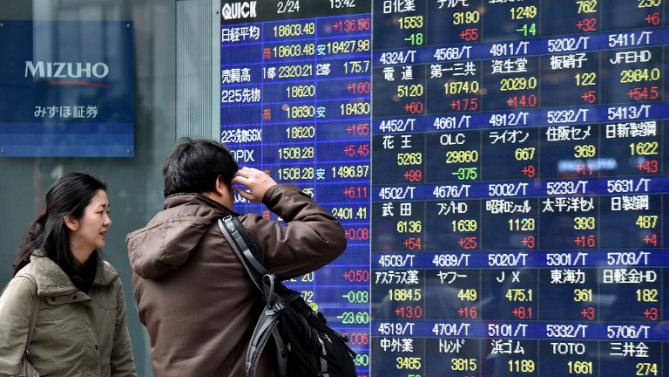
Asian stock markets struggled on Thursday as investors failed to sustain the positive momentum from Wall Street. While a lower-than-expected US inflation report provided some relief, persistent concerns over President Donald Trump’s trade policies continued to weigh on market sentiment.
US Inflation Data Offers Some Relief
Investors have been on edge as governments worldwide grapple with the US president’s tariff policies and threats of further economic measures. However, Wednesday’s data showed that US consumer inflation slowed slightly more than expected in February—the first full month of Trump’s second term.
The report also indicated that core inflation, which excludes volatile food and energy prices, remained below analyst expectations.
National Australia Bank’s Tapas Strickland, however, cautioned that the data “was for February and thus largely pre-dates any potential tariff impacts.”
Markets Remain Cautious Amid Trade War Uncertainty
Despite the temporary relief from the inflation data, investors are still wary of the broader economic implications of Trump’s tariffs, tax cuts, and regulatory policies. Many fear that these measures could reignite inflation, prompt the Federal Reserve to raise interest rates, and ultimately lead to a recession.
Stephen Innes of SPI Asset Management emphasized that while markets reacted positively to the inflation report, uncertainties remain.
“Let’s be clear, this isn’t a free pass to rally unchallenged. The real question now is how far Trump is willing to push on tariffs and government cuts,” Innes stated.
“With April 2’s reciprocal tariff D-Day looming, traders would be foolish to dismiss his resolve to rewrite global trade,” he added, referring to another round of tariffs set to take effect soon.
Asian Markets Trade Mixed
In early Thursday trading, Asian markets showed a mixed performance:
- Tokyo (Nikkei 225): Up 1.0% at 37,173.82
- Hong Kong (Hang Seng Index): Down 0.1% at 23,587.34
- Shanghai Composite: Up 0.1% at 3,373.87
Mark Hackett of Nationwide noted that “for the last three weeks, traders have felt like buying this market is like trying to catch a falling knife.”
Focus on Ukraine Crisis and US-Russia Relations
Markets are also closely monitoring geopolitical tensions, particularly the ongoing Ukraine crisis. Kyiv recently endorsed a US proposal for a 30-day ceasefire, with Washington urging Russia to agree to an unconditional halt to hostilities.
The Kremlin has yet to confirm its stance on the proposal, but Trump has warned of “devastating” sanctions should Russian President Vladimir Putin reject the agreement.
Key Market Indicators (As of 02:30 GMT)
- Euro/USD: Up at $1.0896 from $1.0890 on Wednesday
- Pound/USD: Up at $1.2972 from $1.2969
- Dollar/JPY: Down at 148.17 yen from 148.32 yen
- Brent Crude: Down 0.1% at $70.85 per barrel
- West Texas Intermediate: Down 0.2% at $67.54 per barrel
Conclusion
While the latest US inflation figures provided some temporary relief, market volatility remains high due to lingering trade war concerns and geopolitical uncertainties. With a new round of tariffs set to take effect on April 2, investors will be closely watching how Trump’s policies continue to shape global markets.