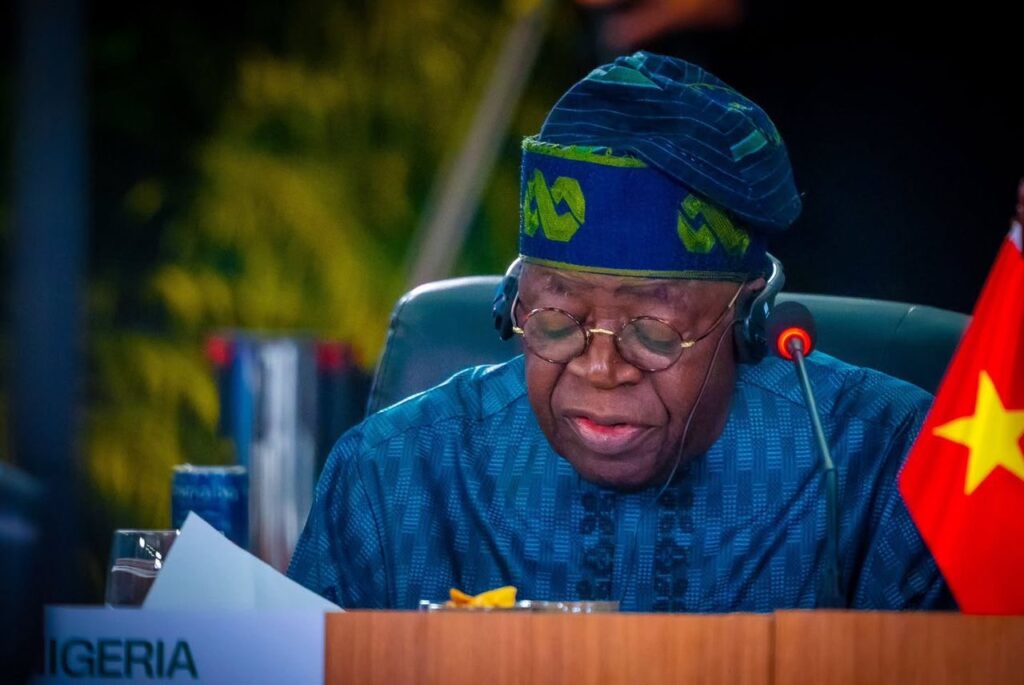
President Bola Ahmed Tinubu has called for an urgent reevaluation of the existing global governance architecture, as well as financial and healthcare systems, emphasizing the need for greater inclusion and fairness for low-income and emerging economies, particularly across Africa.
Speaking on Saturday at the 17th meeting of the Global South and Emerging Economies bloc, BRICS, held in Rio de Janeiro, Brazil, President Tinubu underscored the pressing need to address environmental degradation, climate change, and disparities in healthcare, which he said continue to stifle growth and development across the continent.
Invited to the high-level gathering by Brazilian President Luiz Inácio Lula da Silva, President Tinubu reaffirmed Nigeria’s alignment with BRICS’ call for a more just and inclusive global development model.
“Nigeria aligns with the positions expressed today at BRICS,” President Tinubu stated. “The next critical steps must be global financial restructuring and the reevaluation of governance systems that continue to marginalize emerging economies.”
He noted that Africa, despite contributing the least to global carbon emissions, suffers disproportionately from the effects of climate change. He called for a new path anchored in justice, fair technology transfer, and accessible financing that empowers developing nations to thrive in a rapidly changing global environment.
Highlighting Nigeria’s leadership within Africa, the President cited ongoing national efforts such as the African Carbon Market Initiative and the Great Green Wall Project, and expressed hope that COP-30 would further bolster global resolve for climate justice.
“Nigeria believes deeply in South-South cooperation. We must not remain passive participants in global decision-making,” he said. “On financial reform, climate change, debt relief, environmental sustainability, and healthcare, Africa must have a voice, and Nigeria is ready to lead.”
He added that Nigeria’s development is guided by its Vision 2050, which places strong emphasis on youth empowerment, climate resilience, and inclusive growth. With over 70 percent of its population under the age of 30, the President said it is imperative to build a future that serves the aspirations of young people.
President Tinubu further noted that the country is taking bold steps to accelerate renewable energy adoption, integrate climate action, promote nature-based solutions, and strengthen urban resilience. He also emphasized Nigeria’s commitment to achieving universal health coverage and addressing the rising burden of non-communicable diseases.
“As we look toward COP-30 and a stronger global health architecture, BRICS must evolve as more than just a bloc for emerging economies. It must become a beacon for solutions rooted in solidarity, self-reliance, sustainability, and shared prosperity,” the President affirmed.
“Nigeria remains committed to strategic partnerships that deliver sustainable and inclusive development for all.”
President Tinubu was accompanied to the summit by Ambassador Yusuf Tuggar, Minister of Foreign Affairs, and Mr. Wale Edun, Minister of Finance and Coordinating Minister of the Economy.
Nigeria’s admission as a BRICS partner country was formally announced on January 17, 2025, during Brazil’s pro tempore presidency of the bloc. The country joins Belarus, Bolivia, Cuba, Kazakhstan, Malaysia, Thailand, Uganda, and Uzbekistan in this category, created at the 16th BRICS Summit in Kazan in October 2024.
As Africa’s largest economy and the sixth most populous country in the world, Nigeria continues to play an active role in championing South-South cooperation and advocating for reform in global governance structures, core priorities under Brazil’s current BRICS leadership.
