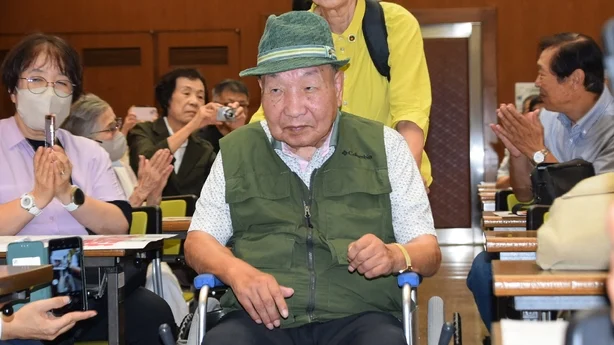
The world’s longest-serving death row prisoner expressed gratitude to his supporters for helping him achieve “complete victory” after a Japanese court last week overturned his decades-old murder conviction.
Iwao Hakamada, 88, was declared innocent of the quadruple murder he was accused of after spending 46 years on death row. Following a long battle for justice led by his sister, Hakamada was exonerated on Thursday.
“Finally, I have won full and complete victory,” he said to a gathering of supporters on Sunday in Shizuoka, the region southwest of Tokyo where the ruling was issued.
“I couldn’t wait any longer” to hear the not-guilty verdict, he added, smiling while wearing a green hat. “Thank you very much,” he said, alongside his 91-year-old sister, Hideko, during the televised meeting.
Japan and the United States are the only major industrialized democracies that still maintain capital punishment, which enjoys widespread support among the Japanese public.
Hakamada is the fifth death row inmate in Japan’s post-war history to be granted a retrial, with all four previous cases resulting in exoneration.
Decades of detention, mostly in solitary confinement under the constant threat of execution, have severely affected Hakamada’s mental health. His lawyer and supporters have described him as living in a “world of fantasy.”
Though Hakamada was released in 2014 pending the retrial, he rarely speaks publicly. Despite the recent verdict, his acquittal is not yet finalized—prosecutors reportedly have until October 10 to decide whether to appeal the Shizuoka District Court’s ruling.
However, they may face challenges, as the court strongly criticized the prosecution, stating that investigators fabricated crucial evidence. The court ruled that Hakamada’s initial confessions, obtained through “inhumane” interrogations and torture, were invalid.
Additionally, blood-stained clothing that was used to implicate him was deemed a setup; the court found that investigators had planted the evidence in a tank of miso paste.
Once the verdict is finalized, Hakamada could be entitled to over 200 million yen ($1.4 million) in compensation under the law, according to estimates from his lawyers. His defense team is also considering filing a new lawsuit against the state for further compensation, as his lead lawyer, Hideyo Ogawa, noted that the ruling condemned a “concerted” effort by prosecutors and police to fabricate evidence.
Hakamada’s absence from the press conference was due to poor health, but Hideko was present and recounted how she broke the news of the acquittal to her brother while he was “relaxing after his bath.”
“He was silent… I think part of him is still in doubt that this really happened,” she shared. When asked about the possibility of prosecutors pursuing the case further, Hideko confidently replied, “If they want to, then go ahead and suit yourself.”
