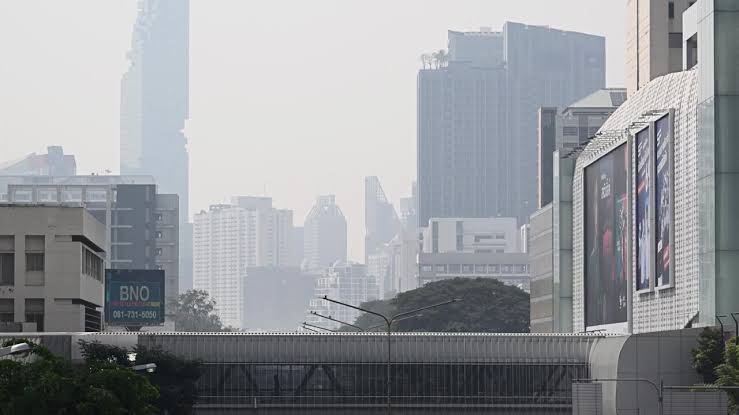
Air pollution in Bangkok forced the closure of over 350 schools on Friday, according to city officials, as the Thai capital ranked as the world’s seventh-most polluted major city, based on data from air quality monitor IQAir.
Seasonal air pollution has long plagued Thailand and other countries in the region. However, this week’s severe haze has led to the largest school closures since 2020. The Bangkok Metropolitan Administration (BMA) announced via its official LINE group that 352 schools across 31 districts were closed due to hazardous air quality.
On Thursday, more than 250 schools in the city had already shut down as authorities urged residents to work from home and imposed restrictions on heavy vehicles. Air pollution in Thailand typically peaks during the cooler months when stagnant winter air traps smoke from crop burning and vehicle emissions.
By Friday, PM2.5 pollutant levels—microscopic particles that can enter the bloodstream through the lungs—reached 108 micrograms per cubic meter, significantly exceeding the World Health Organization’s recommended limit of 15 micrograms for 24-hour exposure.
Bangkok authorities allowed schools in areas with elevated PM2.5 levels to decide on closures. By Friday morning, 352 out of 437 schools under the BMA had suspended classes, affecting thousands of students. This marked the largest number of closures since 2020, when air pollution similarly forced citywide shutdowns of educational institutions.
Interior Minister Anutin Charnvirakul on Thursday ordered a ban on stubble burning—an agricultural practice of clearing fields through intentional fires—warning that offenders could face legal action. Meanwhile, Prime Minister Paetongtarn Shinawatra, attending the World Economic Forum in Switzerland, called for stricter measures to combat pollution. These included limiting construction activities in Bangkok and collaborating with neighboring countries.
Vietnam and Cambodia also reported high pollution levels, with Ho Chi Minh City and Phnom Penh ranking second and fifth, respectively, on IQAir’s list of most-polluted cities globally on Friday. Cambodia’s Environment Ministry, however, insisted its air quality remained within safe limits. “Each country has its own standards,” ministry spokesman Khvay Atitya said, adding that no emergency measures were necessary.
