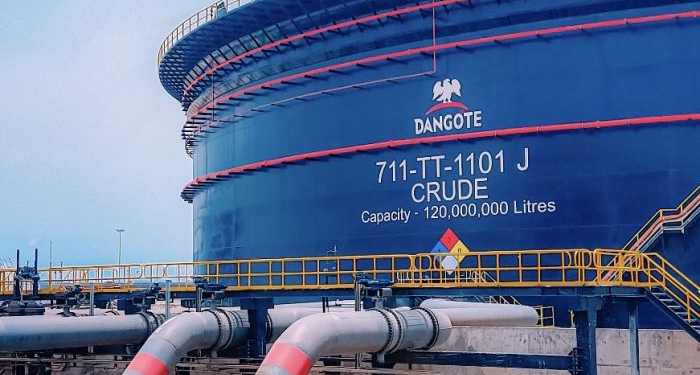
Bulk fuel buyers and independent filling stations in Nigeria are increasingly bypassing middlemen to secure direct supply from the Dangote Refinery, following the company’s rollout of a free fuel distribution scheme that has slashed delivery costs and pump prices.
The development has rattled transport operators who traditionally handled bulk distribution. The President of the National Association of Road Transport Owners (NARTO), Yusuf Othman, raised the alarm during a live programme on TVC News, warning that Dangote’s decision to deliver fuel directly to filling stations, telecom firms, and other bulk users was undermining signed distribution contracts.
Othman explained that NARTO members, who operate about 30,000 trucks, cannot compete with Dangote’s free delivery model. “We have our members who have signed agreements with so many companies. Some are even informal agreements, but we have formal agreements signed, and by that, we used those formal agreements to collect bank facilities to buy trucks and serve those companies. But now, those agreements are at stake because a big brother is coming to supply directly to them, not minding the fact that they have signed agreements with us,” he said.
He added that although the scheme has not been officially confirmed, intelligence from members suggested that Dangote trucks were already making deliveries. “If I sign an agreement with you for service by virtue of my 10 trucks, and somebody somewhere comes to do the same thing for you for free, it’s a very delicate situation,” Othman said, calling on the Federal Government and the Nigerian Midstream and Downstream Petroleum Regulatory Authority (NMDPRA) to intervene, citing Section 212 of the Petroleum Industry Act.
Contacted on Sunday, Othman declined further comment, saying negotiations were underway and a “ceasefire” was being considered.
Before Dangote’s intervention, middlemen bought fuel from refineries or depots and resold to bulk users. That model now appears threatened as buyers rush to register for direct supply in order to cut costs.
The Dangote Refinery flagged off its direct distribution scheme last Monday, deploying more than 1,000 compressed natural gas-powered trucks across Lagos, Ogun, Ondo, Oyo, Osun, Ekiti, Edo, Delta, Rivers, Kwara, and Abuja. The rollout also came with a price reduction. Petrol now retails at ₦841 per litre in Lagos and the South-West, while Abuja, Rivers, Delta, Edo, and Kwara record pump prices of ₦851 per litre.
“The first phase of the deployment will cover the Federal Capital Territory, Lagos, Kwara, Delta, Edo, Rivers, and South-West states, with nationwide expansion planned as additional trucks are delivered,” the Dangote Group said in a statement.
Independent marketers have already confirmed receipt of free deliveries. The National President of the Independent Petroleum Marketers Association of Nigeria (IPMAN), Abubakar Shettima, told The Punch that the refinery had begun supplying filling stations directly.
“Dangote has started the free delivery. Already, the trucks have started moving. In most parts of the Western Zone, they have already started discharging their products, since it is closer to Lagos. So the plan is moving seriously. And my marketers are very pleased with the development. I can confirm to you that my members have started receiving the trucks in Lagos, Ondo, Ogun, Ibadan, and others,” Shettima said.
He added that the new distribution system would immediately reduce prices at filling stations. “Prices would drop from ₦865 to ₦841 the moment petrol gets to the stations under the new arrangement,” he said.
The Dangote refinery, Africa’s largest, has long been touted as a game-changer for Nigeria’s fuel supply chain. But while the direct distribution scheme has been welcomed by marketers and consumers, transport operators warn that it could destabilize existing logistics contracts and put thousands of truck owners at risk.
