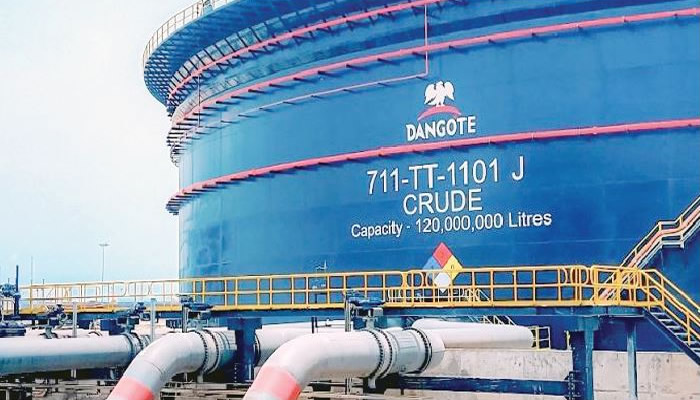
The Dangote Petroleum Refinery has commenced the export of refined petroleum products to neighboring West African countries, signaling its potential to significantly reshape fuel markets in the region.
According to a report by Bloomberg, backed by data from Vortexa, Kpler, Precise Intelligence, and ship-tracking platforms, a shipment of gasoline was recently exported to waters off the coast of Togo. The tanker, CL Jane Austen, reportedly loaded over 300,000 barrels of gasoline from the refinery and sailed west.
This development highlights the growing regional interest in sourcing petroleum products from the mega-refinery. Ghana, for instance, is considering importing from the Dangote Refinery to reduce its reliance on European exports, which cost the nation approximately $400 million monthly. Speaking at the OTL Africa Downstream Oil Conference in Lagos last month, Ghana’s National Petroleum Authority Chairman, Mustapha Abdul-Hamid, emphasized that importing from Nigeria could lower prices by cutting freight costs.
“If the refinery reaches 650,000 barrels per day capacity, all that volume cannot be consumed by Nigeria alone. Instead of importing from Rotterdam, it will be much easier to import from Nigeria, which I believe will bring down our prices,” Abdul-Hamid said.
Reports also suggest that Dangote Refinery has initiated fuel export negotiations with Angola, Namibia, South Africa, and four other African countries, including Niger, Chad, Burkina Faso, and the Central African Republic. Talks with some of these countries are reportedly at advanced stages, while initial discussions have begun with others.
The export marks a significant milestone for the 650,000 barrels-per-day refinery, which shipped its first seaborne gasoline cargo to Lagos last month. The ongoing exports could reduce Africa’s dependence on imported fuel from Europe and the U.S.
While it remains unclear where the current shipment will ultimately end up, the cargo is now floating off the coast of Lomé, Togo, an area often used for ship-to-ship transfers. This suggests that the gasoline could be redistributed to other markets.
Although the volume of gasoline exported so far is small compared to global markets, it signals the refinery’s growing production capabilities. With a potential to export significant volumes, the refinery could disrupt regional fuel markets, driving cost reductions and improving supply chains.
This development also comes as Nigeria ends its state-owned oil company’s monopoly on purchasing fuel from the refinery for domestic use, allowing continued imports from Europe and the U.S. in line with regulatory requirements.
A spokesperson for Dangote Refinery has yet to comment on the recent developments. However, the export activities mark the beginning of what could be a transformative period for Africa’s energy landscape.
