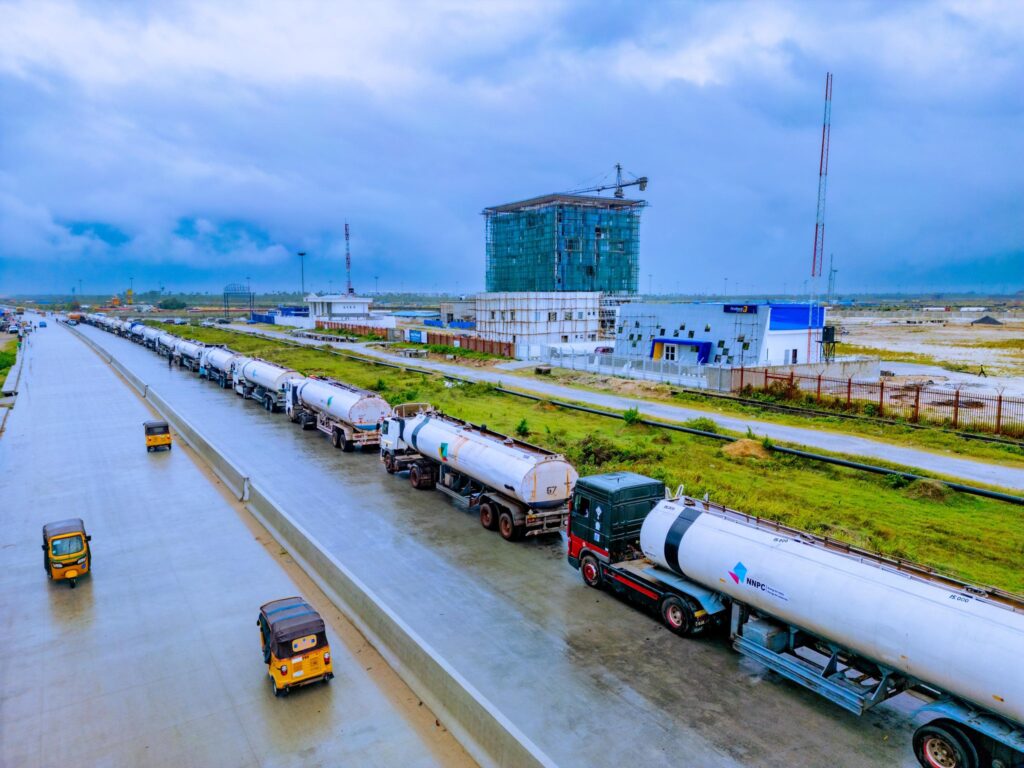
Lagos, Nigeria – In a significant milestone for Nigeria’s oil and gas industry, Dangote Refinery announced on Sunday that the first set of trucks is ready to load Premium Motor Spirit (PMS), commonly known as petrol, from the facility. The refinery made the announcement via a post on its official X (formerly Twitter) account, @DangoteGroup, sharing a video of the trucks set for loading.
The post read: “HAPPENING NOW: First set of trucks set for loading of PMS at the Dangote Petroleum Refinery.”
This marks the first time in years that locally refined petrol will be distributed in Nigeria, a development that has been long awaited since the completion of the Dangote Refinery, the largest of its kind in Africa. The event is seen as a pivotal moment in the country’s journey toward achieving energy self-sufficiency.
On Saturday, the Nigerian National Petroleum Company Limited (NNPCL) also announced that over 300 trucks had arrived at the Dangote Refinery to load petrol, signaling the refinery’s operational readiness.
This comes after previous reports speculated that NNPCL was allegedly delaying crude supply to the Dangote Refinery, potentially hindering its operations. However, NNPCL’s Executive Vice President (Downstream), Dapo Segun, dismissed these claims, reiterating the company’s support for the refinery.
“NNPC has gone out of its way to support the Dangote Refinery, which is what everyone should expect a shareholder to do,” Segun explained. He emphasized that any delays in crude supply were a result of business procedures, not any intentional obstruction. “When people talk about delaying crude supply, they forget that it is a business transaction. There are conditions to be met. If those conditions are not met, it is normal to wait until they are met before you can release the cargo,” Segun clarified.
The Dangote Refinery, a $19 billion project, is expected to transform Nigeria’s fuel supply, reduce reliance on imports, and stabilize the country’s fuel market. The loading of the first trucks is a major step in realizing this vision, signaling the beginning of large-scale domestic production of refined petroleum products.
As operations at the refinery continue to ramp up, it is anticipated that the facility will have a significant impact on the economy, potentially lowering fuel prices and reducing the burden of fuel subsidies on the Nigerian government.
