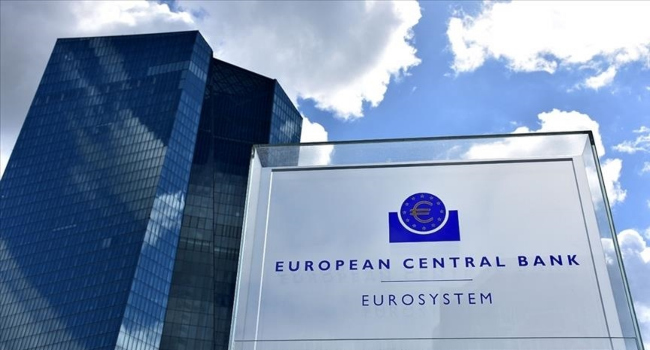
European Central Bank (ECB) policymakers are now leaning towards another interest rate cut as concerns mount over the economic fallout from US President Donald Trump’s tariff policies. As uncertainty surrounding Trump’s next move grows, fears about its negative impact on the eurozone economy are intensifying, prompting the ECB to consider further easing measures.
Once-worrying inflation concerns have largely subsided, with rates drifting back towards the ECB’s target of 2%. However, the global trade tensions triggered by Trump’s controversial tariffs are threatening to shake the foundations of the eurozone’s recovery.
Since June of the previous year, the ECB has reduced interest rates six times, cutting the benchmark deposit rate from 4% to 2.5% to combat rising prices and stimulate growth. While a pause in rate cuts had seemed likely after the March meeting, the latest tariff announcements have made this option less feasible, according to Carsten Brzeski, an analyst at ING Bank.
Trump’s Tariff Strategy Sparks New Concerns
Trump’s most recent round of tariff hikes, which he dubbed “Liberation Day,” involves imposing 10% tariffs on all imports into the United States. Although he has suspended some higher tariffs for 90 days and invited key trading partners to negotiate, the uncertainty surrounding the final trade terms continues to weigh heavily on the eurozone’s economic outlook.
“US tariffs on the EU and many other countries have brought back growth concerns for the eurozone, at least in the nearer term,” Brzeski said. For ECB policymakers, the possibility of a pause in rate cuts is no longer on the table.
Trade Uncertainty and Economic Impact
Ahead of the ECB meeting, uncertainty over the future of transatlantic trade relations has continued to loom large. While Trump recently walked back a proposal to impose a 20% tariff on all EU imports, other tariffs remain firmly in place, including a 25% levy on the automotive, steel, and aluminium industries. These tariffs, coupled with investigations into the semiconductor and pharmaceutical sectors, could lead to further industry-specific trade restrictions.
“Heightened trade uncertainty and tighter financial conditions” caused by Trump’s tariff announcements have increased the “downside” risks for the eurozone, said analysts at UniCredit, an Italian lender. With the eurozone’s economy facing additional pressures, another rate cut to alleviate strain on households and businesses seems to be the most straightforward option.
Despite the growth challenges, the eurozone is set to receive a fiscal boost. Germany’s incoming government, under the leadership of Friedrich Merz, has unveiled plans for a massive infrastructure and defence spending package. However, this stimulus will not take effect until 2026, meaning its positive impact will only be felt in the longer term.
Inflationary Pressures and ECB’s Future Moves
As for inflation, the ECB has seen significant relief. Inflation within the eurozone has fallen from double-digit levels in late 2022 to a more manageable 2.2% in March. The euro has strengthened against the dollar, making imports cheaper, and the tariff battle between the US and China could direct cheaper goods toward Europe.
Merck Finck strategist Robert Greil noted that US tariffs could further suppress inflation within the eurozone, making a decline in prices even more likely. Analysts are closely watching ECB President Christine Lagarde’s upcoming statements for any indication of the bank’s strategy moving forward.
Lagarde has previously signalled the ECB’s readiness to act decisively in response to threats to the eurozone’s financial stability. “The ECB is always ready to use the instruments that it has available,” Lagarde said during a recent speech in Warsaw.
