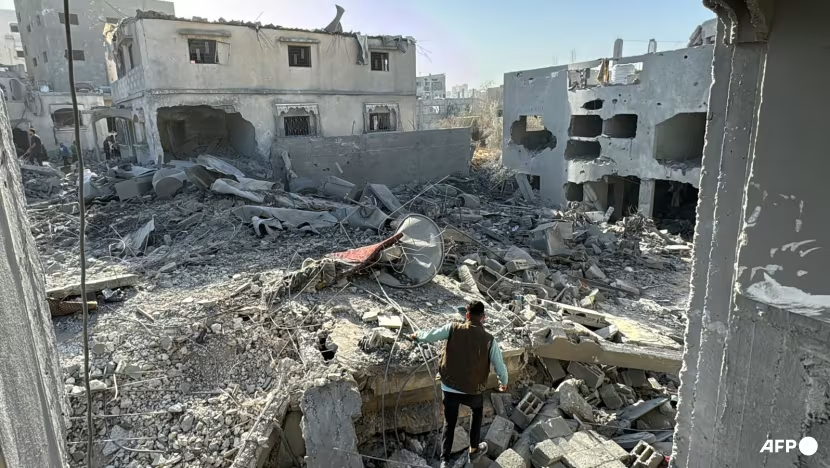
Egyptian President Abdel Fattah al-Sisi proposed a two-day truce in Gaza on Sunday, alongside a limited hostage exchange, as part of efforts to achieve a “complete ceasefire” after over a year of conflict between Israel and Hamas.
Sisi’s plan involves exchanging four Israeli hostages held in Gaza for Palestinian prisoners in Israeli jails, with further negotiations anticipated within ten days. However, he did not confirm whether this proposal had been formally presented to either Israel or Hamas.
This initiative comes as Israel continues its military operations in Gaza, while also engaging in conflict with Hezbollah in Lebanon and recently launching airstrikes against Iran. The strikes on Saturday, the second retaliation for Iranian missile attacks, have sparked global calls for restraint.
The UN Security Council will meet on Monday at Iran’s request, as Tehran seeks condemnation of the Israeli strikes that resulted in four soldier deaths. Iranian leaders downplayed the significance of the attacks, asserting limited damage, while President Masoud Pezeshkian emphasized Iran’s intent to avoid war but promised an “appropriate response.”
Tehran reportedly received warnings from Israel hours before the strikes to prevent escalation. Following the airstrikes, oil prices fell significantly as traders reacted to the news.
Israeli Prime Minister Benjamin Netanyahu described the operation as “precise and powerful,” achieving its objectives, amidst ongoing pressure to secure the release of hostages in Gaza.
Egypt, Qatar, and the United States have been mediating indirect negotiations for months, with little progress. Israeli spy chief David Barnea was scheduled to visit Qatar for talks aimed at reviving negotiations for a hostage deal.
The families of hostages have urged the Israeli government to finalize an agreement, especially following the recent killing of Hamas leader Yahya Sinwar. Key obstacles to a breakthrough remain, including Hamas’s demands for Israel to withdraw entirely from Gaza, which Israeli officials have rejected.
Israeli Defense Minister Yoav Gallant acknowledged that “painful concessions” would be necessary in negotiations, emphasizing that military action alone would not achieve Israel’s goals.
Out of 251 hostages taken by Palestinian militants during the October 7 attack, 97 are still being held in Gaza, with 34 believed dead according to Israeli military reports. Over 100 hostages were released during a previous truce last November.
Amid the ongoing tensions, a truck crashed into a crowd near a central Israeli intelligence complex, resulting in one death and over two dozen injuries.
In Lebanon, Israeli strikes on Sunday killed at least 21 people, including nine near Sidon and seven in the southern village of Ain Baal. The conflict has left at least 1,615 dead in Lebanon since September 23, with the true toll likely higher.
The Israeli military reported killing 70 Hezbollah fighters while losing five of its own troops during recent operations in Lebanon. Heavy bombing also continued in Gaza, with the Israeli military claiming to have killed an additional 40 militants.
UN Secretary-General Antonio Guterres expressed grave concern for the civilians in Gaza, stating that their suffering is “unbearable.” Local residents report dire conditions, with widespread famine and restricted movement.
Sisi highlighted the urgent need for humanitarian aid to enter Gaza, warning of potential famine. Recent reports indicated that an Israeli strike on a school sheltering displaced Palestinians resulted in at least nine deaths, a claim the Israeli military is currently investigating.
The Israeli offensive in Gaza was launched following the October 7 attack by Hamas, which killed 1,206 people, mostly civilians, according to official Israeli figures. Since then, at least 42,924 Palestinians, primarily civilians, have died in the conflict, as reported by the health ministry in Gaza, which the UN considers credible.
The war has drawn in Iran-backed groups across the region, including Hezbollah in Lebanon and militias in Iraq, Syria, and Yemen.
