European leaders expressed cautious optimism on Wednesday after a high-stakes virtual meeting with former U.S. President Donald Trump, just two days before his scheduled summit with Russian President Vladimir Putin in Alaska to discuss ending the war in Ukraine.
According to French President Emmanuel Macron, Trump signaled that his primary goal at the upcoming U.S.-Russia talks was to secure a ceasefire between Moscow and Kyiv. Trump also reportedly agreed that any territorial settlements must involve Ukrainian President Volodymyr Zelensky and include concrete security guarantees.
Speaking after the call, Macron said the discussion helped “clarify his intentions” and allowed European leaders to “express our expectations.”
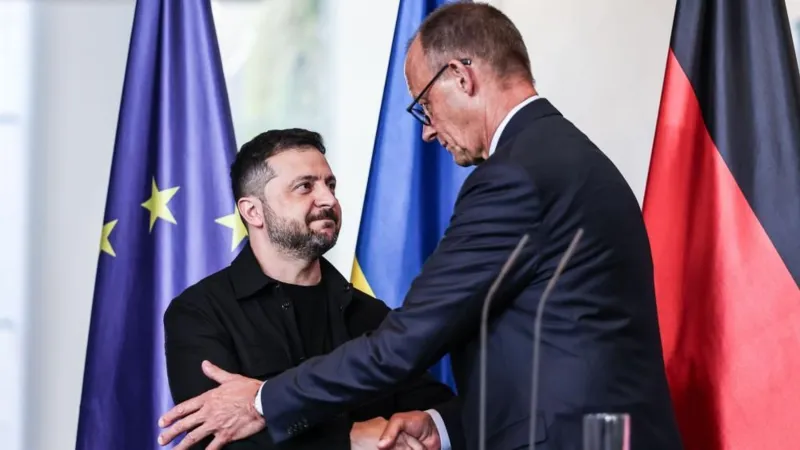
The call included UK Prime Minister Sir Keir Starmer, German Chancellor Friedrich Merz, Italian Prime Minister, Finnish and Polish leaders, European Commission President Ursula von der Leyen, and NATO chief Mark Rutte. U.S. Vice President JD Vance also participated.
Starmer is set to meet Zelensky in London on Thursday at 10 Downing Street — just 24 hours before Trump and Putin convene in Alaska.
Europe Pushes to Keep Ukraine at the Table
The hastily arranged Trump-Putin summit has largely excluded European input, prompting Wednesday’s call as a last-minute bid to ensure Ukraine’s interests and Europe’s security concerns remain central.
By Wednesday night, Trump described the meeting with European leaders as “a 10” and warned that Russia would face “very severe” consequences if it failed to halt its invasion. He also suggested that, if Friday’s talks went well, he might quickly arrange a second round involving both Putin and Zelensky.
Still, European leaders reiterated the need for Ukraine’s direct involvement in any final deal — a sign of lingering unease that Trump could concede Ukrainian territory to secure a ceasefire.
“It’s most important that Europe convinces Donald Trump that one can’t trust Russia,” said Poland’s Donald Tusk. Merz stressed that Ukraine “must be at the table as soon as follow-up meetings take place.”
If Russia refused concessions, Merz added, “then the United States and we Europeans should and must increase the pressure.”
Concerns Over ‘Land-Swapping’ and Russia’s Demands
Since the summit was announced last week, Trump has hinted at potential “land-swapping” between Kyiv and Moscow — sparking alarm in Ukraine and among NATO allies.
Russia’s position, reaffirmed Wednesday by Foreign Ministry spokesperson Alexey Fadeev, remains unchanged: Ukraine must withdraw from the partially occupied regions of Donetsk, Luhansk, Kherson, and Zaporizhzhia, and formally abandon its bid to join NATO.
Kyiv and its European partners have rejected those terms as unacceptable. Zelensky has repeatedly warned that any territory ceded to Russia would become a staging ground for future aggression.
Security guarantees — commitments to defend Ukraine long-term — emerged as a potential counterbalance to these threats. Starmer said “real progress” had been made in that area, praising Trump’s involvement:
“For three-and-a-bit years this conflict has been going on and we haven’t got anywhere near the prospect of an actually viable solution… Now we do have that chance, because of the work the president has put in.”
Coalition of the Willing and Frontline Updates
Since spring, the UK and France have led a “Coalition of the Willing” — a group of nations pledging to deter further Russian advances. On Wednesday, the coalition reaffirmed its readiness to deploy a “reassurance force” after hostilities end, though details remain unclear.
Meanwhile, fighting continues on the front lines. In Donetsk, Russian forces advanced near Dobropillya in their summer offensive. Zelensky dismissed Moscow’s resilience claims, saying, “I told Trump and our European allies that Putin is bluffing,” and urged “more pressure” on Russia.
Trump acknowledged that persuading Putin to stop killing civilians may be beyond reach:
“I’ve had that conversation with him… but then I go home and see that a rocket has hit a nursing home or an apartment building… So I guess the answer to that is probably no.”
