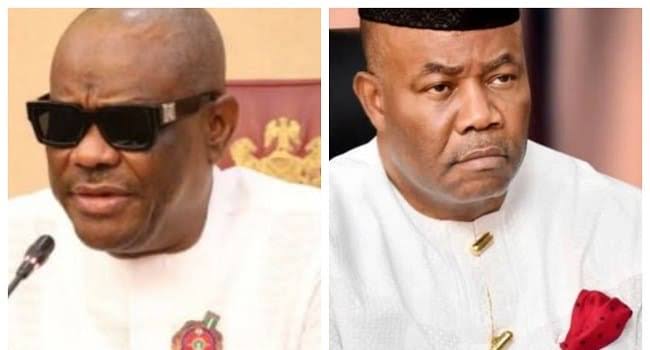
Striking resident doctors in the Federal Capital Territory (FCT) have called on Minister Nyesom Wike and Senate President Godswill Akpabio to utilize public hospitals in Abuja as a way to understand the severe challenges faced by health workers and patients in the nation’s healthcare system.
Speaking during an appearance on Channels Television’s Politics Today on Wednesday, the President of the Association of Resident Doctors (FCT Chapter), George Ebong, stressed the need for government officials to experience the realities of public healthcare firsthand.
“If we are ready to fix the healthcare system in this country, I would think that every government official must use the government hospitals. Let’s start with that,” Ebong stated.
He specifically urged Wike to visit Wuse General Hospital, the Senate President to use Maitama General Hospital, and the Speaker of the House of Representatives to patronize Nyanya General Hospital. “Then, we can start to fix the system. If they don’t use it, then we can’t fix it. I’m sorry, but that’s the truth,” he said.
Hospitals Paralyzed Amid Warning Strike
The doctors commenced a three-day warning strike on Wednesday over grievances including unpaid salaries and allowances. This strike followed the expiration of a three-week ultimatum issued to the government, resulting in a near-total shutdown of services at government hospitals across Abuja, from Wuse and Maitama to Asokoro, Kubwa, Nyanya, and others.
According to Ebong, the state of healthcare facilities in the FCT is dire, with many hospitals lacking basic infrastructure, equipment, and manpower.
“For example, we don’t have electricity; sometimes you can’t run some tests over the weekend. We don’t have drugs, we don’t have scan machines working, and we don’t have enough manpower. In some hospitals, only one doctor is available to handle patients,” he revealed.
Wike’s Focus Misplaced, Say Doctors
While acknowledging Minister Wike’s focus on infrastructure projects like road construction, the doctors criticized the neglect of healthcare. Ebong referred to public hospitals as “hallowed ground” that should not be overlooked in any development agenda.
“The minister has been very busy with projects, fixing roads and all of that. We feel that he should also focus on the hospitals right now. No matter the things he does by fixing roads and bridges, the hospitals should be a priority,” he said.
The doctors’ strike has highlighted the broader struggles of Nigeria’s public healthcare system, often characterized by inadequate funding, poor working conditions, and deteriorating infrastructure.
As residents grapple with disrupted medical services, the striking doctors and health advocates continue to demand urgent government intervention to address the crisis.
