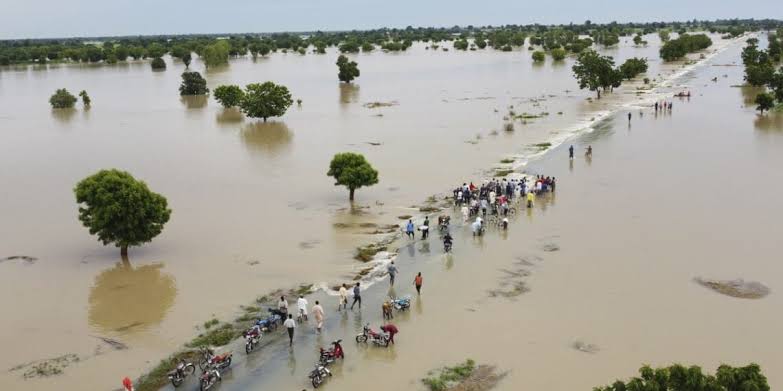
As Nigeria continues to face the aftermath of severe floods in Maiduguri, Borno State, and other parts of the country, the Federal Government has issued a critical warning regarding potential flooding along the Niger and Benue rivers.
During a press briefing in Abuja on Friday, the Minister of Water Resources and Sanitation, Prof. Joseph Utsev, alerted the public about the large volume of water flowing through these rivers, emphasizing the need for increased vigilance and proactive measures, particularly in southern Nigeria, to mitigate the risk of future flooding.
Utsev attributed the recent flooding in Maiduguri and Jere, Borno State, to the overflow of Alau Dam, located about 10 kilometers from Maiduguri, caused by a massive inflow from the Ngadda River, a key tributary of the River Yedzaram.
He referenced the 2024 Annual Flood Outlook by the Nigeria Hydrological Services Agency, which identified high, moderate, and low flood-risk areas across the country. Borno, Bauchi, Jigawa, Taraba, Yobe, Benue, and Gombe are among the 31 states listed as high-risk. “The flood disaster in Maiduguri and Jere was due to the overflow of water from Alau Dam, following significant inflow from Ngadda River,” Utsev stated.
He also mentioned his visit to Maiduguri with the Minister of State, Bello Goronyo, and ministry officials to assess the damage and express solidarity with the state governor. A team of experts from the National Water Resources Institute, Nigeria Hydrological Services Agency, and Chad Basin Development Authority are currently on-site, evaluating the situation at Alau Dam and formulating recommendations.
“As we recover from this disaster, we must remain cautious of water contamination to prevent outbreaks of waterborne diseases,” Utsev warned.
Amidst mourning in states like Borno, Yobe, Jigawa, and Bauchi, Utsev called for continued vigilance, noting that water levels on the Niger and Benue rivers were rising, signaling a potential red alert for further flooding in southern Nigeria.
The Federal Government attributed the flooding in Borno to climate change and prolonged heavy rainfall. Contrary to earlier reports, Utsev clarified that the Alau Dam did not collapse during the flood. He reiterated that a prior flood warning had identified 31 states, including Borno, as high-risk.
According to the National Emergency Management Agency, the flooding, which began on Tuesday, has claimed more than 30 lives and displaced over 400 people. Initial reports had mistakenly suggested that the Alau Dam had collapsed.
In a statement issued by Funmi Imuetinyan, Director of Information and Public Relations at the Ministry of Water Resources and Sanitation, Utsev announced plans to upgrade the Alau Dam. “We are committed to a comprehensive overhaul of this vital infrastructure. The Alau Dam upgrade is essential, and any substandard work or delays by contractors will be met with sanctions,” he asserted.
The dam, constructed in 1986, has a maximum storage capacity of 112 million cubic meters and supplies water for irrigation and domestic use in the state capital.
