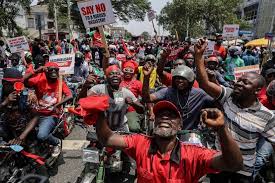
Hundreds of Ghanaians, primarily university students, took to the streets of Accra on Thursday to demand an immediate end to illegal mining activities.
The demonstrators, who plan to hold protests over the next three days, are also calling for the release of 54 activists detained last month for opposing illegal mining.
The government’s response to illegal mining—especially its effects on natural resources and rural livelihoods—has emerged as a critical issue ahead of the presidential elections in December.
“If our leaders don’t act now, future generations will suffer,” said Delali Asante, a University of Ghana student, speaking to AFP.
Chanting the national anthem and singing patriotic songs, the protesters, dressed in red and black, marched through the capital. Many held up bottles of polluted water from the Pra and Birim rivers, two of Ghana’s largest, to illustrate the environmental devastation caused by illegal mining.
These rivers are a crucial source of drinking water for many Ghanaians.
“Our water bodies are being destroyed, and soon we’ll have nothing left,” Asante added. “We can’t drink gold, and we can’t grow crops on poisoned land.”
Protest leader Henry Tagoe emphasized, “We cannot sit by and watch our rivers become contaminated with mercury. Illegal mining is destroying our environment and jeopardizing our future.”
Labour unions have announced a nationwide strike starting October 10 to pressure authorities for urgent action.
The protesters are also demanding the release of 54 members of the Democracy Hub pressure group, arrested on September 22 and 23 for road blockages and burning tires, who have been remanded in custody for two weeks—an action that has sparked public outrage.
Ghana, home to 33 million people, is a major producer of gold and cocoa. Since 2022, the country has faced an economic crisis marked by rampant inflation, leading to defaults on foreign debt.
These economic challenges have prompted many cocoa farmers to sell their land to illegal mining operations, which not only consume agricultural land but also pollute rivers and water supplies with harmful chemicals used in gold extraction.
“We will not stop until we see real change,” Tagoe vowed. “This is not just about us; it’s about protecting Ghana’s future.”
