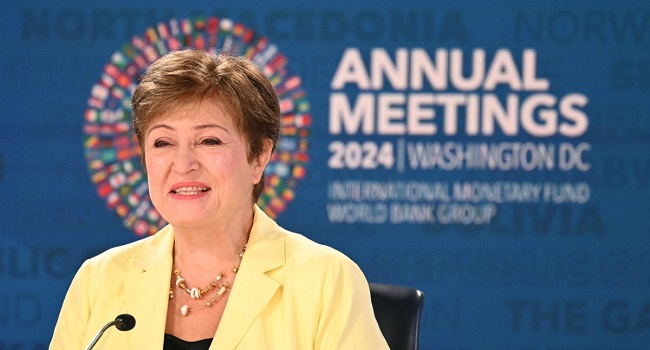
The International Monetary Fund (IMF) is seeking more information about a cross-border payments system discussed by the BRICS group—Brazil, Russia, India, China, and South Africa—that aims to facilitate transactions outside the dollar-based system. The IMF’s managing director, Kristalina Georgieva, expressed the Fund’s interest in understanding the proposed BRICS Cross-Border Payments Initiative (BCBPI), which was unveiled at a recent BRICS summit in Kazan, Russia.
The Kazan meeting occurred concurrently with the IMF and World Bank’s annual meetings in Washington. BRICS, which has expanded to include countries like Iran, Egypt, and the United Arab Emirates, now represents a significant portion of global economic output. At the summit, the BRICS coalition agreed to encourage the use of local currencies for settlements within the group, strengthening their correspondent banking networks in alignment with the BCBPI initiative. The proposed system is intended as an alternative to the SWIFT payment system, from which Russia was removed following its 2022 invasion of Ukraine.
Georgieva, speaking at the IMF’s headquarters, emphasized the need for clarity on the initiative before forming a judgment. “The idea of having a payments system of a group of countries is not new,” she noted. “What we need to see is more details. What is it in this idea? How that may translate into reality? And then we will be able to assess it.”
As part of her press conference, Georgieva also highlighted the IMF’s two key objectives for the global economy: managing inflation to reach central bank targets without triggering a recession and addressing the “low growth, high debt path” that many nations face.
Georgieva additionally addressed the economic impact of the conflict in the Middle East, particularly for Egypt, which she said is losing 70% of its Suez Canal revenue due to regional instability. Earlier this month, Egyptian President Abdel Fattah El-Sisi reported the country had lost $6-7 billion in Suez Canal income this year. Consequently, the IMF recently downgraded growth projections for the Middle East and North Africa region by 0.6 percentage points.
In her remarks, Georgieva also commended advancements in global debt restructuring through the Global Sovereign Debt Roundtable (GSDR), an IMF-led forum that facilitates dialogue between creditors and debtor nations. While noting that the GSDR has helped make the debt restructuring process “more predictable and efficient,” she underscored the need for further measures to assist countries in financial distress.
“We need to do more to help countries in debt distress get back on their feet faster,” Georgieva concluded.
