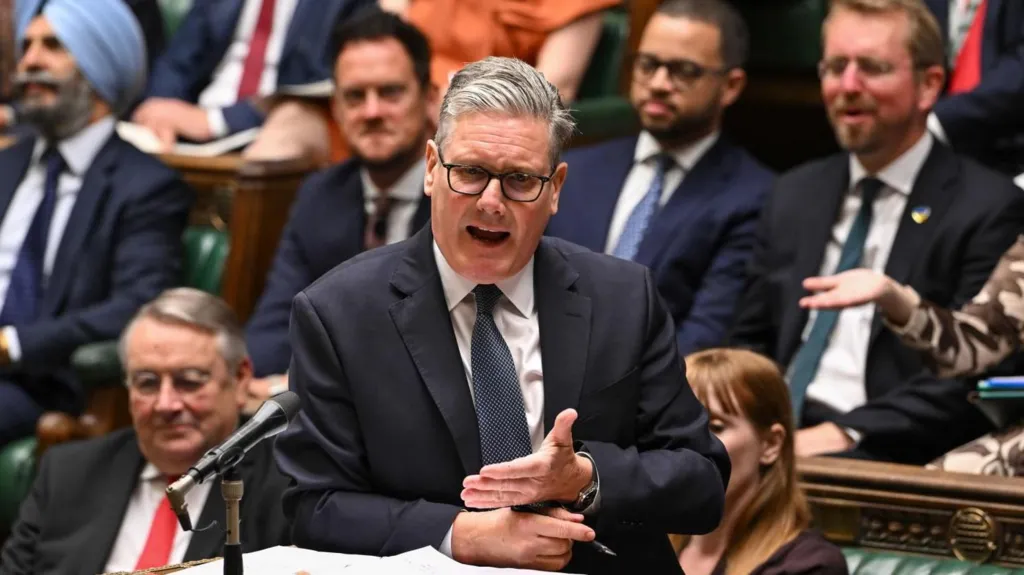
In a bold move reminiscent of his actions last year, Prime Minister Sir Keir Starmer has once again shown his authority within the Labour Party, suspending four Members of Parliament (MPs) and stripping three others of their trade envoy roles. This latest round of expulsions follows a rebellion by Labour MPs over the government’s controversial welfare cuts, reflecting Starmer’s efforts to quell dissent and restore party discipline ahead of the summer break.
A Year of Rebellion and Consequences
Just a year after removing seven Labour MPs from the party for voting against the two-child benefit cap, Starmer has once again wielded the whip. Four MPs have been expelled from the Labour Party, meaning they will now sit as independents in the House of Commons, while three others have been stripped of their roles as unpaid trade envoys. This comes as the government seeks to enforce a clear line on party loyalty, particularly following the recent benefits rebellions that saw Labour MPs challenge the government on welfare policies.
The expelled MPs were summoned to meet with Chief Whip Sir Alan Campbell after Prime Minister’s Question Time, while the trade envoys received calls from Downing Street to inform them that their services were no longer required.
Rebellion, Defiance, and Discontent
The expulsions have sparked mixed reactions within the Labour Party. While some MPs have expressed their support for Starmer’s actions, viewing it as necessary to maintain party unity, others have reacted with outrage. One suspended MP described the decision as “ridiculous” and “vindictive,” while another labelled it a sign of “weakness” and “pettiness.”
One of the expelled MPs, who had been a member for less than a year, spoke emotionally about the loss of their position. Despite their disappointment, they expressed a sense of defiance, signalling that this move would not silence their political views.
The expulsions appear to have been motivated by a desire to send a message to other Labour MPs, discouraging any future rebellion, particularly on issues like the changes to special educational needs provision in England. Senior Labour figures have indicated that these actions were not prompted by isolated instances of disobedience, but by a pattern of repeated defiance against government policies.
A Divided Response
Some Labour MPs view Starmer’s actions as a necessary step to reinforce party unity, while others see it as a heavy-handed response that damages morale. “They’re public executions!” one Labour MP said, commenting on the spectacle of MPs being removed from internal party discussions and WhatsApp groups.
One of the suspended trade envoys expressed a resigned understanding of the decision, but described the move as “petty and a bit pointless.” Their frustration was compounded by the perception that the decision was also politically motivated, with the fact that all of the MPs removed were from minority ethnic backgrounds not going unnoticed.
Strained Morale Within the Party
Concerns about the impact of these suspensions on party morale are mounting. “Morale is already down in the dumps among the base, among members and councillors,” one Labour figure remarked. “How is this going to help?” Critics of Starmer’s leadership are quick to draw comparisons to past leaders like Harold Wilson and Tony Blair, who they argue would not have resorted to such drastic measures.
While Starmer has sought to increase his engagement with MPs in recent weeks, following criticism of his perceived detachment, these expulsions seem to send a starkly different message. MPs had hoped for a more inclusive approach, especially after recent turbulent weeks, but this latest development suggests that discipline remains a priority.
The Road Ahead
As Labour heads into its summer recess, Sir Keir Starmer faces a critical test. He must balance the need to maintain party discipline with the risk of alienating members. For now, the suspensions are intended to be a clear signal to MPs, but the long-term impact on party cohesion remains to be seen.
